
What is RAG AI? Retrieval-Augmented Generation is a technique that connects a large language model to an external knowledge source at the moment it generates a response, allowing the model to pull in current, specific, and verifiable information rather than relying solely on what it learned during training. The result is an AI system that answers questions with real data rather than generalized approximations.
If you have ever asked a standard AI assistant a question about your company's internal processes and received an answer that sounded reasonable but was completely made up, you have experienced the core limitation that RAG was designed to solve. Language models are trained on data up to a fixed point in time. They know nothing about your proprietary documentation, your current inventory, your latest policies, or anything that happened after their training cutoff. RAG changes that fundamental limitation by giving the model a mechanism to look things up before it answers, the same way a well-prepared analyst consults source documents before giving advice rather than working entirely from memory. For businesses deploying AI in contexts where accuracy and specificity matter, understanding what RAG AI is and how it works is not a technical nicety. It is the difference between an AI that actually helps and one that confidently produces plausible nonsense.

Why Standard Language Models Have a Fundamental Knowledge Problem
The Training Cutoff Limitation
Every large language model in existence today was trained on a dataset with a defined end date. Everything that happened after that date, every policy change, every product update, every regulatory development, every piece of organizational knowledge created since the model was trained, is invisible to it. For general knowledge tasks this limitation is manageable because foundational knowledge changes slowly. For business applications where accuracy on current, specific information is the entire point, it is a serious operational problem.
The second limitation is scope. Even the largest language models trained on the broadest possible datasets have no knowledge of information that was never in their training data. Your company's internal knowledge base, your customer contracts, your technical documentation, your pricing structures, and your operational procedures were almost certainly never in any public training dataset. A model answering questions about these topics is not retrieving information it knows. It is generating text that sounds like an answer based on patterns in its training, a process that produces fluent, confident responses that may have no relationship to the actual facts.
This phenomenon has a name in AI research: hallucination. It describes the tendency of language models to generate factually incorrect information presented with the same confident tone as accurate information. For casual use cases, hallucination is an inconvenience. For business applications in legal, medical, financial, or operational contexts, it is a liability.
How RAG Addresses Both Problems at Once
What is RAG AI solving specifically? It addresses both the cutoff problem and the scope problem with a single architectural addition. Rather than asking the model to answer from training data alone, RAG systems retrieve relevant documents or data from an external source at query time and include that retrieved content in the context the model uses to generate its response.
The model is not guessing at what your refund policy says. It retrieved the actual policy document before responding. It is not estimating what your Q3 revenue figures were. It pulled the actual figures from your financial system before answering. The model's role shifts from sole knowledge source to intelligent synthesizer of retrieved information, which is a task language models do extraordinarily well.
This architectural shift has implications that go well beyond fixing hallucinations. It means AI systems can be updated by updating their knowledge sources rather than retraining their models. It means responses can cite their sources, making verification straightforward. And it means organizations can build AI systems with access to genuinely sensitive internal knowledge without that knowledge ever needing to be included in a training dataset.
How RAG AI Actually Works
The Retrieval Pipeline Explained
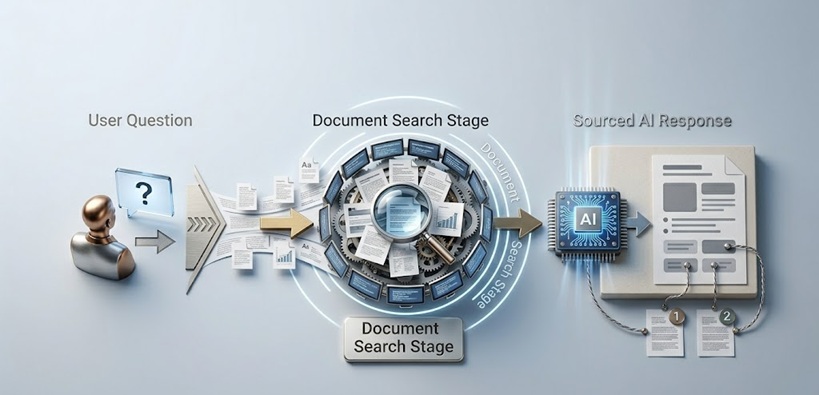
A RAG system has two major components working in sequence before the language model ever generates a word of its response.
The first component is the knowledge base and its indexing infrastructure. Documents, records, web pages, database entries, or any other information the AI should be able to draw on get processed and stored in a way that makes them searchable by meaning rather than just by keyword. This typically involves converting text into numerical representations called embeddings, which capture semantic meaning in a form that allows mathematically similar content to be retrieved together. A question about customer refund processes retrieves content about returns, exchanges, and satisfaction guarantees even if those exact words do not appear in the query.
The second component is the retrieval mechanism that activates when a user submits a query. The query is converted into the same embedding format as the stored documents, and the system identifies the stored content most semantically similar to the query. That retrieved content, the passages, documents, or records most relevant to the question being asked, gets assembled and passed to the language model along with the original query.
The language model then generates a response grounded in that retrieved context rather than relying on its training data for the specific facts required. The training data still matters for the model's language ability, its reasoning capacity, and its general world knowledge. But the specific factual content of the response comes from the retrieved material.
| RAG System Component | What It Does | Why It Matters |
|---|---|---|
| Document Ingestion | Processes and chunks source documents for indexing | Determines what knowledge the system can access |
| Embedding Model | Converts text to semantic vector representations | Enables meaning-based retrieval rather than keyword matching |
| Vector Database | Stores embeddings for fast similarity search | Makes retrieval fast enough for real-time use |
| Retrieval Mechanism | Identifies most relevant content for each query | Determines accuracy of retrieved context |
| Language Model | Generates response grounded in retrieved content | Produces coherent, synthesized output from retrieved facts |
| Source Attribution | Tracks which documents informed each response | Enables verification and builds user trust |
Understanding how AI architecture decisions in RAG pipelines affect both retrieval quality and response accuracy helps organizations build systems that perform reliably rather than well in demonstrations and inconsistently in production.
RAG vs Standard LLM: Where the Difference Shows Up in Practice
The distinction between what is RAG AI and what a standard LLM does becomes most visible in the specific scenarios where standard models fail and RAG systems succeed.
A standard LLM asked about your organization's current data retention policy generates a response based on common data retention practices from its training data. It may sound exactly right. It is almost certainly not describing your actual policy. A RAG system asked the same question retrieves your actual policy document and generates a response grounded in what that document says. The language is similar. The accuracy is categorically different.
A standard LLM asked about a customer complaint submitted yesterday has no idea what you are talking about. The complaint postdates its training. A RAG system connected to your CRM retrieves the complaint record and generates a response that reflects the actual details of that specific customer's situation.
A standard LLM asked to summarize the key findings from a research report you uploaded may produce a plausible-sounding summary that omits critical findings, misrepresents conclusions, or combines details from different parts of the document inaccurately. A RAG system retrieves the specific sections most relevant to the summary request and generates output grounded in the actual text.
| Scenario | Standard LLM Response | RAG AI Response |
|---|---|---|
| Internal policy question | Generates plausible generic answer not specific to your policies | Retrieves actual policy document, answers from its content |
| Question about recent event | States it has no information or generates outdated answer | Retrieves current information from connected knowledge base |
| Customer-specific inquiry | Cannot access individual customer data | Retrieves relevant customer records and responds accurately |
| Technical documentation query | May hallucinate technical details | Retrieves specific documentation sections and cites them |
| Competitive intelligence | Limited to training data, often outdated | Retrieves current information from connected sources |
| Compliance question | Answers from general regulatory knowledge | Retrieves applicable rules and organization-specific procedures |
Where Businesses Are Deploying RAG AI Most Effectively
Internal Knowledge Management
The internal knowledge management use case is where RAG AI delivers some of its clearest business value. Most organizations have substantial institutional knowledge distributed across documentation repositories, wikis, past project files, policy documents, and communications that employees spend significant time searching through manually. A RAG system over that knowledge base turns it into a conversational resource that staff can query in natural language and receive accurate, sourced answers from.
The compounding value here is substantial. Experienced employees who hold organizational knowledge in their heads eventually leave. Documentation that exists but is hard to find is functionally almost as inaccessible as documentation that does not exist. RAG systems make organizational knowledge accessible to all staff regardless of tenure, reduce the time spent searching for information, and surface relevant knowledge in the context where it is needed rather than requiring employees to know where to look.
Reviewing how AI features in enterprise RAG platforms handle access control on retrieved content is essential for this use case because not all organizational knowledge should be equally accessible to all employees. A well-configured RAG system retrieves only the content that the querying user is authorized to access, not everything in the knowledge base.
Customer-Facing Support and Service
RAG-powered customer service applications represent one of the most commercially impactful deployments of this technology. A customer service AI backed by a RAG pipeline over your product documentation, troubleshooting guides, order management system, and policy database can answer specific, accurate questions about a customer's actual situation rather than generating generic responses that send customers to human agents for the specific information they needed.
The business case is straightforward. Accurate first-contact resolution reduces support costs, reduces escalations to human agents, and produces better customer outcomes. The technical foundation that makes accurate first-contact resolution possible for AI systems is almost always RAG. Without retrieval, the model cannot access the current, customer-specific information that accurate support responses require.
Compliance and Regulatory Applications
Financial services, healthcare, legal, and other heavily regulated industries are deploying RAG AI over regulatory document sets to help compliance teams navigate complex, frequently updated rule sets more efficiently. A compliance officer who can query a RAG system over the full text of applicable regulations, guidance documents, and internal policy frameworks and receive accurate, sourced answers to specific compliance questions works more efficiently and with more confidence than one relying on memory or manual document review.
The citation capability of RAG systems is particularly valuable in compliance contexts. An answer that cites the specific regulatory paragraph it draws from is verifiable and defensible in a way that an AI-generated answer without sourcing is not. That difference matters enormously when the answer informs a decision with regulatory consequences.
Understanding how AI security requirements apply to RAG systems connected to sensitive regulatory and compliance data helps organizations build retrieval pipelines that maintain appropriate access controls across the documents they index.

Building a RAG System That Actually Works
The Data Quality Problem Most Projects Underestimate
RAG systems are only as good as the content they retrieve from. Organizations that rush past data quality assessment to get to the exciting part of building the AI interface consistently discover that the retrieval quality determines the response quality far more than the choice of language model does. Poor source documents, outdated content, inconsistently formatted information, and knowledge bases that have not been maintained produce RAG systems that retrieve the wrong content and generate responses that are grounded in bad information rather than no information.
The practical implication is that knowledge base preparation is not a preliminary step to be completed quickly before the real work begins. It is a core part of the project that determines whether the deployed system is useful. Document quality review, content currency assessment, deduplication of conflicting versions, and access control mapping all need to happen before the indexing infrastructure is built.
Chunking Strategy Affects Everything Downstream
How source documents get divided into retrievable units before indexing has a larger effect on retrieval quality than most teams realize when they start building RAG systems. Chunks that are too small lose the contextual information that makes their content meaningful. Chunks that are too large retrieve more than is relevant and dilute the signal the language model uses to generate accurate responses. The optimal chunking strategy depends on the document types in the knowledge base, the nature of typical queries, and the context window of the language model being used.
Testing retrieval quality with representative queries before deploying to users surfaces chunking problems when they can still be addressed rather than after users have experienced inconsistent response quality.
A comprehensive AI guide on RAG implementation methodology helps organizations structure their build process around the decisions that most affect production quality rather than the ones that are most technically interesting during development.
Things To Know
Several important realities about RAG AI that organizations typically discover during or after their first deployment:
Retrieval quality and generation quality are separate problems requiring separate evaluation. A RAG system can retrieve the right content and generate a poorly synthesized response, or retrieve the wrong content and generate a fluent response that sounds accurate but is not. Testing both components independently before evaluating end-to-end system performance identifies where problems actually live.
RAG does not eliminate hallucination, it reduces it. A language model generating a response from retrieved context can still produce inaccurate content by misinterpreting retrieved material, combining information incorrectly, or generating details not present in the retrieved context. Hallucination risk is substantially lower with good retrieval than without it, but human review remains important for high-stakes applications.
Embedding model choice affects retrieval quality significantly. Different embedding models perform better on different types of content. A model optimized for general text retrieval may perform poorly on technical documentation, legal language, or domain-specific terminology. Testing retrieval quality with your actual document types and query patterns before committing to an embedding model prevents expensive rearchitecting later.
Knowledge base maintenance is an ongoing operational function, not a one-time setup task. As source documents are updated, new content is added, and outdated content becomes misleading, the RAG knowledge base needs to be updated correspondingly. Organizations that treat the initial indexing as the completion of knowledge base work end up with systems whose accuracy degrades as the gap between indexed content and current reality widens.
Access controls need to be enforced at retrieval time, not just at knowledge base ingestion. A user who should not see certain documents should not receive responses grounded in those documents even if the documents are indexed in the system. Retrieval-time permission enforcement is a security requirement, not an optional enhancement.
The 30% rule applies usefully to RAG deployment planning. AI retrieval and synthesis should handle roughly 30% of knowledge work, the lookup and synthesis component, while human expertise handles the judgment, interpretation, and consequential decision-making that constitutes the remaining 70%. Designing RAG deployments around this balance creates systems that genuinely augment human knowledge work rather than attempting to replace the judgment that still needs to stay with people.
Why RAG AI Is Becoming the Standard Architecture for Business AI
What is RAG AI in the broader context of enterprise AI adoption? It is the architectural pattern that makes language models practically useful for the specific, current, organizational knowledge tasks that businesses actually need AI to handle. The combination of a language model's ability to reason, synthesize, and communicate in natural language with a retrieval system's access to current, specific, verifiable information produces something neither component delivers alone.
Organizations that have deployed standard language models and been disappointed by hallucinations, outdated knowledge, and inability to handle company-specific questions are often deploying the right technology in the wrong architecture. The same models, connected to well-built retrieval pipelines over well-maintained knowledge bases, produce dramatically different and dramatically more useful results.
The technical barrier to building RAG systems has dropped significantly over the last two years. The frameworks, vector databases, and hosted retrieval infrastructure that make RAG practical are mature, well-documented, and accessible to engineering teams without specialized AI research backgrounds. What separates successful RAG deployments from disappointing ones is less about technical sophistication and more about the organizational discipline to prepare knowledge bases properly, evaluate retrieval quality rigorously, and maintain the system as a living operational asset rather than a completed project.
Frequently Asked Questions
What is the difference between GPT and RAG?
GPT is a type of large language model that generates responses based entirely on patterns learned during training, while RAG is an architectural approach that connects any language model, including GPT, to external knowledge sources that get retrieved and included in the model's context at response time. GPT without retrieval answers from training data alone, while a GPT-based RAG system retrieves relevant current information before generating its response, producing answers that are grounded in specific, verifiable sources rather than training data generalizations.
What is the difference between RAG and generative AI?
Generative AI is the broad category of AI systems that produce new content including text, images, and audio, while RAG is a specific technique applied to text-generating AI that augments generation with a retrieval step pulling relevant information from external sources before the model generates its response. All RAG systems are generative AI, but most generative AI systems are not RAG systems. RAG is an architectural enhancement that makes generative AI more accurate and current for knowledge-intensive tasks.
What is RAG vs LLM?
An LLM is a language model that generates text based on training data, while RAG is an architecture that pairs an LLM with a retrieval system so the model generates responses grounded in retrieved documents rather than training data alone. The LLM in a RAG system handles language understanding and generation while the retrieval component handles finding current, specific information relevant to each query. Together they produce outputs that are more accurate, verifiable, and organizationally relevant than either component produces independently.
What problems does RAG solve?
RAG primarily solves three problems: the training cutoff limitation that makes standard LLMs unable to answer questions about recent events or current information, the scope limitation that prevents models from knowing about proprietary organizational knowledge that was never in public training data, and the hallucination problem where models generate plausible but inaccurate responses when they lack the specific knowledge a question requires. By retrieving relevant content before generating responses, RAG grounds AI outputs in verifiable sources rather than statistical patterns, producing answers that can be checked, cited, and trusted for business-critical applications.
Which 3 jobs will survive AI?
The three categories of work most resilient to AI displacement are roles requiring physical world interaction and dexterity in unstructured environments, roles centered on complex human judgment, ethical reasoning, and accountability for consequential decisions, and roles built around interpersonal trust, emotional intelligence, and relationship management. RAG AI and similar systems are making knowledge retrieval and synthesis highly automatable, which reinforces the value of the distinctly human capabilities these roles depend on rather than the information processing tasks that AI now handles more efficiently.