
AI in cybersecurity explained simply means the use of machine learning, pattern recognition, and automated reasoning to detect, prevent, and respond to digital threats faster than any human team could manage alone. Instead of waiting for a known threat to match a signature in a database, AI watches behavior in real time and flags anomalies before damage is done.
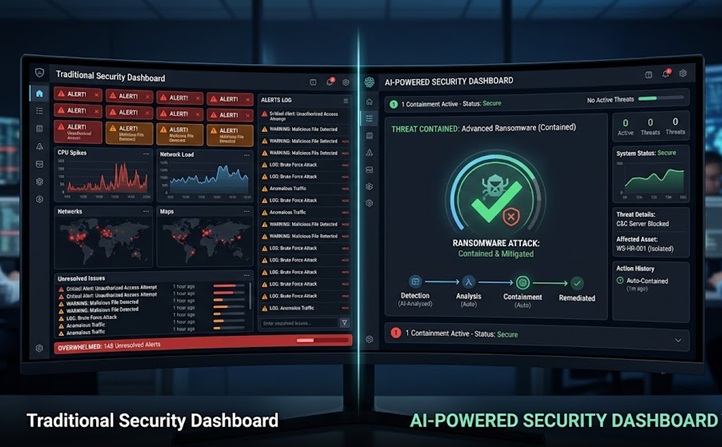
Traditional security tools work reactively. They know what to look for because someone already saw it before. AI flips that model on its head. It learns what normal looks like across your entire network, and the moment something deviates from that baseline, it responds. For businesses managing remote teams, sensitive client data, or cloud infrastructure, that shift from reactive to proactive is the difference between catching a breach in seconds and discovering it three months later in a news headline.
Why Conventional Cybersecurity Is No Longer Enough
Picture a security guard who memorizes a list of known criminals and checks every person entering a building against that list. That approach works until a criminal who has never been caught walks through the front door. Classic cybersecurity tools work almost exactly the same way. They rely on signatures, known threat patterns, and predefined rules. The moment an attacker does something new, those tools are essentially blind.
The numbers behind this problem are uncomfortable. Cybercriminals launch attacks faster than security teams can write new rules to stop them. Phishing campaigns, ransomware variants, and supply chain compromises all evolve rapidly and deliberately to stay ahead of traditional defenses. Many organizations are running security stacks that were designed for a threat landscape that no longer exists.
This is the environment that made AI in cybersecurity not just useful but necessary. Understanding how AI security architecture is built helps clarify why the technology represents a genuine structural shift rather than a marginal improvement on old tools.
AI doesn't get tired, doesn't miss patterns buried across millions of log entries, and doesn't need to have seen a threat before to recognize that something is wrong. Those three qualities alone make it categorically different from anything that came before it.
How AI Actually Works in a Cybersecurity Context
The phrase "AI in cybersecurity" gets thrown around loosely, so it's worth being specific about what the technology is actually doing inside a modern security stack.
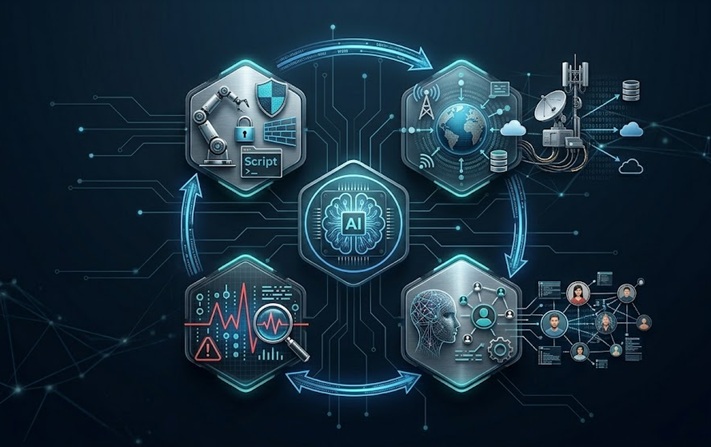
Behavioral Analysis: AI systems ingest enormous volumes of activity data, user logins, file access patterns, network traffic, application behavior, and build a model of what normal looks like for your specific environment. When something deviates from that baseline, even subtly, the system flags it. A user who normally logs in from London suddenly accessing sensitive files at 3am from an unfamiliar device in a different country isn't necessarily a breach, but it's worth investigating immediately rather than discovering it next quarter.
Threat Detection and Classification: Machine learning models trained on historical attack data can classify incoming threats by type, severity, and likely origin with remarkable speed. What would take a human analyst hours to triage can be categorized and prioritized in milliseconds, allowing security teams to focus attention where it's needed most.
Automated Response: Some AI systems don't just detect threats, they act on them. When a known attack pattern is confirmed, the system can automatically isolate the affected device, revoke credentials, block traffic from a suspicious IP address, or trigger an incident response workflow without waiting for human approval.
Predictive Risk Scoring: Rather than treating all assets equally, AI assigns dynamic risk scores based on exposure, vulnerability history, and current threat intelligence. This helps security teams make better decisions about where to invest time and resources.
Real Examples of AI in Cybersecurity
Knowing the theory matters, but seeing how this plays out in practice makes it concrete. Here are situations where AI-driven security tools have changed outcomes in meaningful ways.
Insider Threat Detection: A financial services firm noticed that a departing employee had begun downloading unusual volumes of documents in the weeks before their resignation. Their AI-driven data loss prevention system flagged the behavioral change automatically. The security team intervened before any proprietary data left the building. Without AI monitoring the pattern, the activity would have looked like normal file access until it was too late.
Phishing at Scale: Email security platforms using AI analyze thousands of signals per message including sender reputation, link behavior, language patterns, and metadata to catch sophisticated phishing attempts that bypass traditional filters. These are emails crafted specifically to look legitimate, and AI catches them at a rate human review never could.
Zero-Day Vulnerability Response: When a previously unknown vulnerability is exploited in the wild, AI systems monitoring network behavior can detect the anomalous traffic patterns associated with the attack and respond before a patch even exists. This is one of the most critical advantages AI brings to a security stack.
Fraud Detection in Financial Systems: Banks use AI to review millions of transactions per day, flagging the small percentage that show patterns consistent with fraud. The system learns what legitimate transactions look like for each customer individually, making it far more precise than rules-based approaches that generate constant false positives.
The 7 Main Types of AI That Power Cybersecurity Tools
Understanding which types of AI show up in security tools helps cut through the marketing noise and evaluate platforms more accurately.
| AI Type | How It's Used in Cybersecurity |
|---|---|
| Machine Learning | Learns threat patterns from historical data to classify and detect attacks |
| Deep Learning | Processes complex, unstructured data like images and documents for malware analysis |
| Natural Language Processing | Analyzes text in emails, logs, and documents to detect phishing and insider threats |
| Expert Systems | Applies rule-based logic to automate decision-making in incident response |
| Reinforcement Learning | Trains systems to improve threat response through feedback loops over time |
| Generative AI | Used by both attackers (crafting phishing content) and defenders (simulating attacks) |
| Anomaly Detection Models | Establishes behavioral baselines and flags deviations in real time |
Most enterprise security platforms combine several of these rather than relying on a single approach. The combination of behavioral anomaly detection with machine learning classification, for example, produces far fewer false positives than either method alone.
Things To Know
- AI doesn't replace your security team. It amplifies what they can do. Analysts who used to spend hours reviewing alerts can now focus on the threats that actually matter while AI handles triage.
- Attackers are using AI too. Generative AI has made it significantly easier to craft convincing phishing emails, generate malware variants, and automate reconnaissance. The defensive use of AI isn't optional; it's a response to offensive AI already being deployed against you.
- False positives are still a challenge. Even the best AI security systems generate noise. Tuning the system to your specific environment and feeding it quality data over time reduces this, but it requires investment and patience.
- AI security tools need good data to work well. A system trained on incomplete or low-quality log data will produce incomplete and low-quality detections. Garbage in, garbage out applies to security AI just as much as any other model.
- The 30% rule applies here too. AI should be doing the heavy lifting on detection and triage, but human judgment remains essential for complex investigation, strategic response decisions, and anything with legal or reputational consequences.
- Compliance and AI don't automatically align. Automated AI responses that block access or modify systems may create audit trail requirements. Check that your AI security tools log decisions in ways your compliance framework requires.
- Smaller organizations benefit most from managed AI security. You don't need an enterprise budget to access AI-driven threat detection. Managed security service providers now offer AI-powered monitoring as a service at accessible price points.
The 3 C's of AI Applied to Cybersecurity
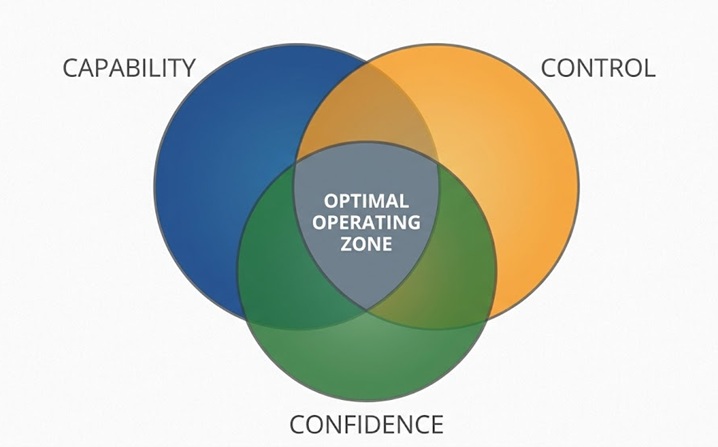
The 3 C's framework, Capability, Control, and Confidence, provides a useful lens for evaluating how well your organization is actually using AI in its security posture rather than just deploying it.
Capability in cybersecurity AI means honestly assessing what your tools can and cannot detect. An AI system excellent at network anomaly detection may have limited visibility into endpoint behavior or cloud workloads. Knowing the edges of your capability map is essential for identifying blind spots before attackers do.
Control refers to how much oversight your team has over AI-driven decisions. When an AI system automatically isolates a device or blocks an account, someone needs to review that decision quickly. AI in cybersecurity explained correctly always includes the human governance layer, not just the technical one. The features that enable meaningful human control over AI security decisions are often what separate enterprise-grade tools from consumer-grade ones.
Confidence is about understanding how much you can trust your AI security outputs given the quality of your data, the tuning of your models, and the coverage of your deployment. Overconfidence in AI detections can lead to complacency. Underconfidence leads to ignoring alerts that matter. Calibrating confidence accurately is an ongoing process, not a one-time setup task.
Comparing AI-Powered and Traditional Cybersecurity Approaches
| Capability | Traditional Security | AI-Powered Security |
|---|---|---|
| Threat Detection Speed | Hours to days | Seconds to minutes |
| Unknown Threat Handling | Limited, relies on known signatures | Can detect novel behavior patterns |
| Alert Volume Management | Manual triage, often overwhelming | Automated prioritization and filtering |
| Scalability Across Environments | Difficult across cloud and remote setups | Scales to cover distributed infrastructure |
| Continuous Learning | Static rules require manual updates | Models improve with new data over time |
| Human Analyst Load | High, reactive | Reduced, focused on complex cases |
What This Means for Your Organization Right Now
AI in cybersecurity explained at a practical level means one thing for most business leaders: the question is no longer whether to adopt AI-driven security tools, but how to do it without creating new risks in the process.
The transition from traditional to AI-powered security isn't always smooth. Legacy systems may not integrate cleanly with AI platforms. Teams may need training to trust and interpret AI-generated alerts. Procurement processes may not be equipped to evaluate AI security vendors on the dimensions that actually matter, like data handling, model transparency, and update frequency.
These are solvable problems, but they require treating AI security adoption as an organizational change initiative, not just an IT procurement decision. The organizations getting the most value from AI-driven security tools are the ones that have aligned their security strategy, their technology stack, and their team capabilities around a shared understanding of what AI can and cannot do.
Understanding how to approach AI implementation as a guide for your whole organization is a productive starting point for any leadership team ready to move from curiosity to commitment on this topic.
The threat landscape is not getting simpler. Attackers are better resourced, more automated, and more patient than they have ever been. AI in cybersecurity isn't a solution to that problem on its own, but it is currently the most significant tool organizations have for keeping pace.
AI in Cybersecurity Explained: Building the Right Foundation
Getting AI in cybersecurity explained clearly is the first step. Putting it into practice is where the real work begins. The organizations that invest now in understanding the technology, selecting the right platforms, training their teams, and building governance frameworks will be significantly better positioned than those waiting for a breach to motivate action.
Security has always been about preparation, not reaction. AI gives organizations the tools to prepare more intelligently than ever before. The question is whether they're willing to use them.
Frequently Asked Questions
How does AI work in cyber security?
AI in cybersecurity works by analyzing large volumes of data in real time to identify behavioral anomalies, classify threats, and automate responses before human analysts could even finish reading the alert. It learns what normal looks like in your environment and flags deviations continuously.
What are the 7 main types of AI?
The seven main types are machine learning, deep learning, natural language processing, expert systems, reinforcement learning, generative AI, and anomaly detection models. Most enterprise security platforms combine several of these rather than relying on a single approach.
What are examples of AI in cybersecurity?
Examples include AI-driven email filtering that catches sophisticated phishing attempts, behavioral analytics tools that detect insider threats, and automated incident response systems that isolate compromised devices without waiting for human approval. Fraud detection in financial systems is another widely deployed example.
What is the 30% rule for AI?
The 30% rule suggests AI should handle roughly 30% of any given workflow, with human judgment covering the rest to catch errors and apply context. In cybersecurity, this translates to AI managing detection and triage while analysts focus on investigation and strategic response.
What are the 3 C's of AI?
The 3 C's stand for Capability, Control, and Confidence, a framework for honestly evaluating what your AI tools can do, how much human oversight exists, and how much you can trust the outputs. In cybersecurity, applying this framework regularly helps prevent both overreliance and underuse of AI-driven tools.