
Architecture Overview
Triggerfish is a secure, multi-channel AI agent platform with a single core invariant:
SECURITY Security is deterministic and sub-LLM. Every security
decision is made by pure code that the LLM cannot bypass, override, or influence. The LLM has zero authority -- it requests actions; the policy layer decides. :::
This page provides the big picture of how Triggerfish works. Each major component links to a dedicated deep-dive page.
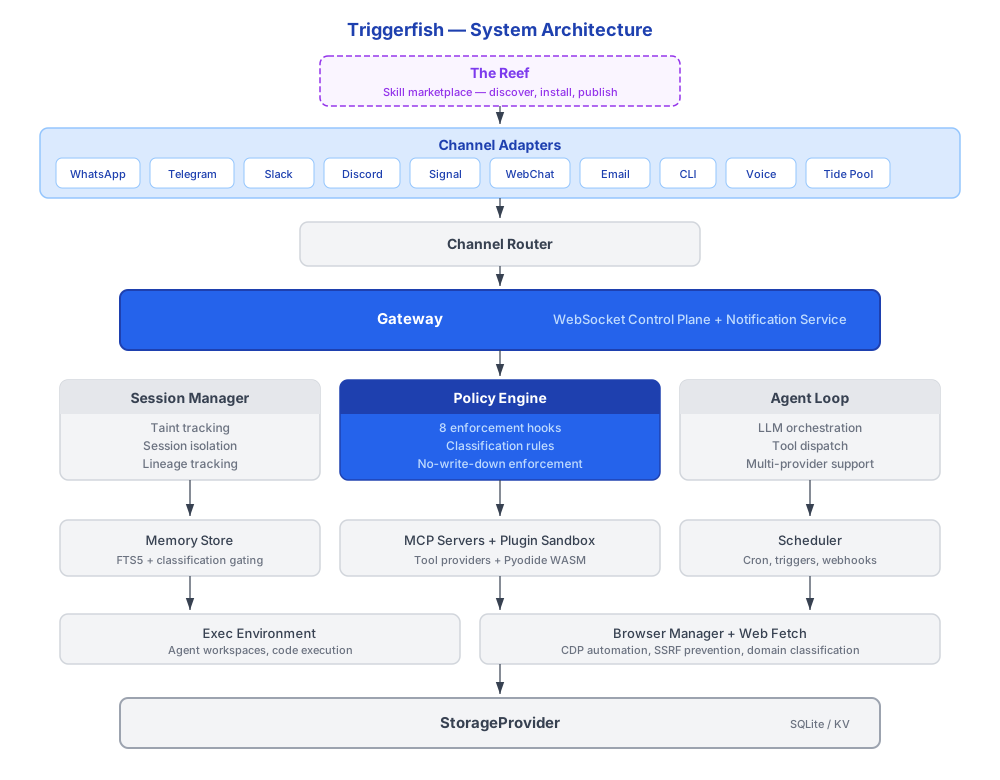
System Architecture
Data Flow
Every message follows this path through the system:
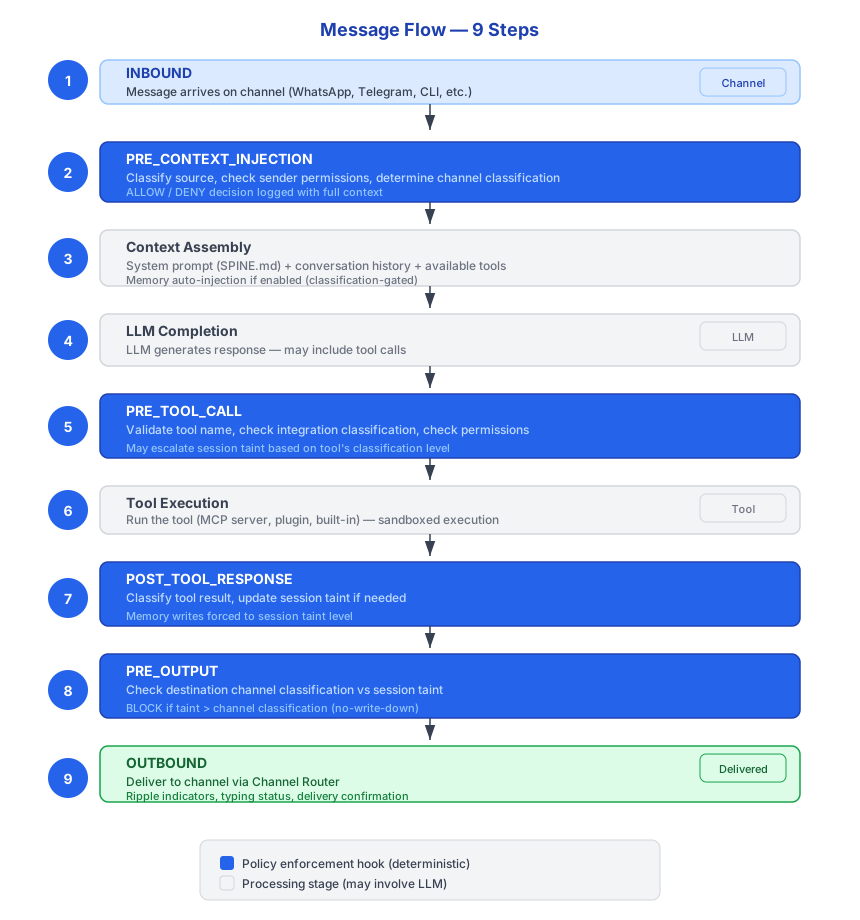
At every enforcement point, the decision is deterministic -- the same input always produces the same result. There are no LLM calls inside hooks, no randomness, and no way for the LLM to influence the outcome.
Major Components
Classification System
Data flows through four ordered levels: RESTRICTED > CONFIDENTIAL > INTERNAL > PUBLIC. The core rule is no write-down: data can only flow to equal or higher classification. A CONFIDENTIAL session cannot send data to a PUBLIC channel. No exceptions. No LLM override.
Read more about the Classification System.
Policy Engine and Hooks
Eight deterministic enforcement hooks intercept every action at critical points in the data flow. Hooks are pure functions: synchronous, logged, and unforgeable. The policy engine supports fixed rules (never configurable), admin-tunable rules, and declarative YAML escape hatches for enterprise.
Read more about the Policy Engine.
Sessions and Taint
Each conversation is a session with independent taint tracking. When a session accesses classified data, its taint escalates to that level and can never decrease within the session. A full reset clears taint AND conversation history. Every data element carries provenance metadata through a lineage tracking system.
Read more about Sessions and Taint.
Gateway
The Gateway is the central control plane -- a long-running local service that manages sessions, channels, tools, events, and agent processes through a WebSocket JSON-RPC endpoint. It coordinates the notification service, cron scheduler, webhook ingestion, and channel routing.
Storage
All stateful data flows through a unified StorageProvider abstraction. Namespaced keys (sessions:, taint:, lineage:, audit:) keep concerns separated while allowing backends to be swapped without touching business logic. The default is SQLite WAL at ~/.triggerfish/data/triggerfish.db.
Defense in Depth
Security is layered across 13 independent mechanisms, from channel authentication and permission-aware data access through session taint, policy hooks, plugin sandboxing, filesystem tool sandboxing, and audit logging. No single layer is sufficient alone; together they form a defense that degrades gracefully even if one layer is compromised.
Read more about Defense in Depth.
Design Principles
| Principle | What it means |
|---|---|
| Deterministic enforcement | Policy hooks use pure functions. No LLM calls, no randomness. Same input always produces same decision. |
| Taint propagation | All data carries classification metadata. Session taint can only escalate, never decrease. |
| No write-down | Data cannot flow to a lower classification level. Ever. |
| Audit everything | All policy decisions logged with full context: timestamp, hook type, session ID, input, result, rules evaluated. |
| Hooks are unforgeable | The LLM cannot bypass, modify, or influence policy hook decisions. Hooks run in code below the LLM layer. |
| Session isolation | Each session tracks taint independently. Background sessions spawn with fresh PUBLIC taint. Agent workspaces are fully isolated. |
| Storage abstraction | No module creates its own storage. All persistence flows through StorageProvider. |
Technology Stack
| Component | Technology |
|---|---|
| Runtime | Deno 2.x (TypeScript strict mode) |
| Python plugins | Pyodide (WASM) |
| Testing | Deno built-in test runner |
| Channels | Baileys (WhatsApp), grammY (Telegram), Bolt (Slack), discord.js (Discord) |
| Browser automation | puppeteer-core (CDP) |
| Voice | Whisper (local STT), ElevenLabs/OpenAI (TTS) |
| Storage | SQLite WAL (default), enterprise backends (Postgres, S3) |
| Secrets | OS keychain (personal), vault integration (enterprise) |
Triggerfish requires no external build tools, no Docker, and no cloud
dependency. It runs locally, processes data locally, and gives the user full sovereignty over their data. :::