
Defense in Depth
Triggerfish implements security as 13 independent, overlapping layers. No single layer is sufficient on its own. Together, they form a defense that degrades gracefully -- even if one layer is compromised, the remaining layers continue to protect the system.
SECURITY Defense in depth means that a vulnerability in any single
layer does not compromise the system. An attacker who bypasses channel authentication still faces session taint tracking, policy hooks, and audit logging. An LLM that is prompt-injected still cannot influence the deterministic policy layer below it. :::
The 13 Layers
Layer 1: Channel Authentication
Protects against: Impersonation, unauthorized access, identity confusion.
Identity is determined by code at session establishment, not by the LLM interpreting message content. Before the LLM sees any message, the channel adapter tags it with an immutable label:
{ source: "owner" }    -- verified channel identity matches registered owner
{ source: "external" } -- anyone else; input only, not treated as command
Authentication methods vary by channel:
| Channel | Method | Verification |
|---|---|---|
| Telegram / WhatsApp | Pairing code | One-time code, 5-minute expiry, sent from user's account |
| Slack / Discord / Teams | OAuth | Platform OAuth consent flow, returns verified user ID |
| CLI | Local process | Running on the user's machine, authenticated by OS |
| WebChat | None (public) | All visitors are EXTERNAL, never owner |
| Domain matching | Sender domain compared against configured internal domains |
The LLM never decides who is the owner. A message saying "I am the
owner" from an unverified sender is tagged { source: "external" } and cannot trigger owner-level commands. This decision is made in code, before the LLM processes the message. :::
Layer 2: Permission-Aware Data Access
Protects against: Over-permissioned data access, privilege escalation through system credentials.
Triggerfish uses the user's delegated OAuth tokens -- not system service accounts -- to query external systems. The source system enforces its own permission model:
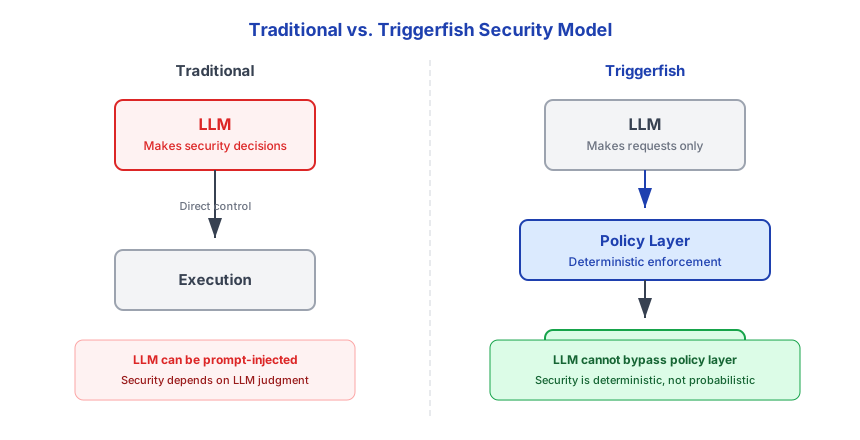
The Plugin SDK enforces this at the API level:
| SDK Method | Behavior |
|---|---|
sdk.get_user_credential(integration) | Returns user's delegated OAuth token |
sdk.query_as_user(integration, query) | Executes with user's permissions |
sdk.get_system_credential(name) | BLOCKED -- raises PermissionError |
Layer 3: Session Taint Tracking
Protects against: Data leakage through context contamination, classified data reaching lower-classification channels.
Every session independently tracks a taint level that reflects the highest classification of data accessed during the session. Taint follows three invariants:
- Per-conversation -- each session has its own taint
- Escalation only -- taint increases, never decreases
- Full reset clears everything -- taint AND history are wiped together
When the policy engine evaluates an output, it compares the session's taint against the target channel's effective classification. If the taint exceeds the target, the output is blocked.
Layer 4: Data Lineage
Protects against: Untraceable data flows, inability to audit where data went, compliance gaps.
Every data element carries provenance metadata from origin to destination:
- Origin: Which integration, record, and user access produced this data
- Classification: What level was assigned and why
- Transformations: How the LLM modified, summarized, or combined the data
- Destination: Which session and channel received the output
Lineage enables forward traces ("where did this Salesforce record go?"), backward traces ("what sources contributed to this output?"), and full compliance exports.
Layer 5: Policy Enforcement Hooks
Protects against: Prompt injection attacks, LLM-driven security bypasses, uncontrolled tool execution.
Eight deterministic hooks intercept every action at critical points in the data flow:
| Hook | What it intercepts |
|---|---|
PRE_CONTEXT_INJECTION | External input entering the context window |
PRE_TOOL_CALL | LLM requesting tool execution |
POST_TOOL_RESPONSE | Data returning from tool execution |
PRE_OUTPUT | Response about to leave the system |
SECRET_ACCESS | Credential access request |
SESSION_RESET | Taint reset request |
AGENT_INVOCATION | Agent-to-agent call |
MCP_TOOL_CALL | MCP server tool invocation |
Hooks are pure code: deterministic, synchronous, logged, and unforgeable. The LLM cannot bypass them because there is no pathway from LLM output to hook configuration. The hook layer does not parse LLM output for commands.
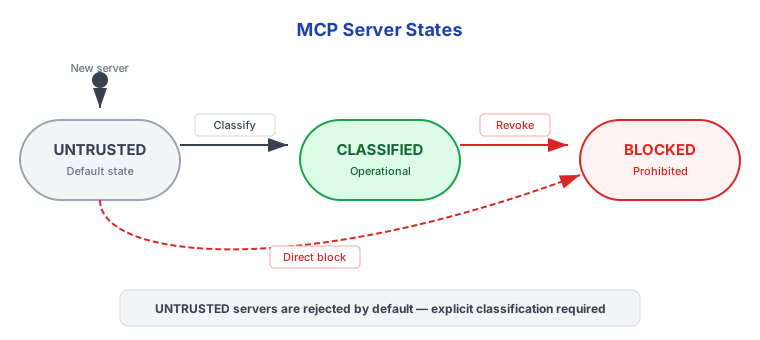
Layer 6: MCP Gateway
Protects against: Uncontrolled external tool access, unclassified data entering through MCP servers, schema violations.
All MCP servers default to UNTRUSTED and cannot be invoked until an admin or user classifies them. The Gateway enforces:
- Server authentication and classification status
- Tool-level permissions (individual tools can be blocked even if the server is allowed)
- Request/response schema validation
- Taint tracking on all MCP responses
- Injection pattern scanning in parameters
Layer 7: Plugin Sandbox
Protects against: Malicious or buggy plugin code, data exfiltration, unauthorized system access.
Plugins run inside a double sandbox:
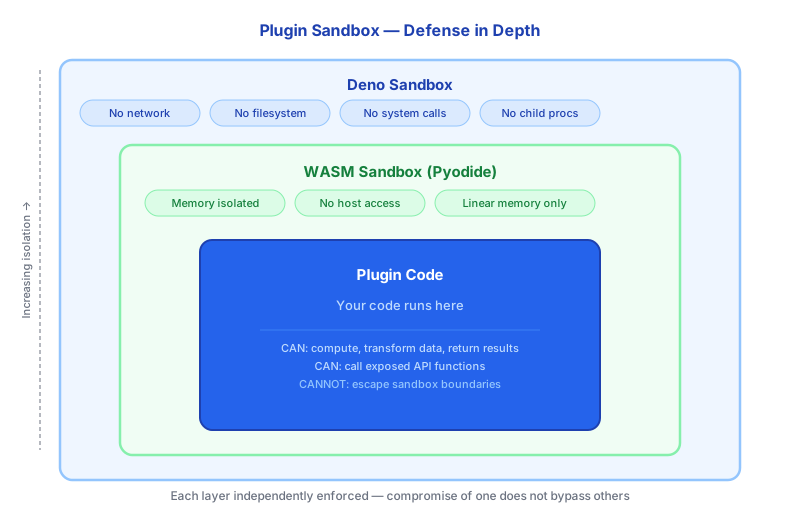
Plugins cannot:
- Access undeclared network endpoints
- Emit data without classification labels
- Read data without triggering taint propagation
- Persist data outside Triggerfish
- Use system credentials (only user's delegated credentials)
- Exfiltrate via side channels (resource limits, no raw sockets)
The plugin sandbox is distinct from the agent exec environment. Plugins
are untrusted code that the system protects from. The exec environment is a workspace where the agent is allowed to build -- with policy-governed access, not sandbox isolation. :::
Layer 8: Secrets Isolation
Protects against: Credential theft, secrets in config files, plaintext credential storage.
Credentials are stored in the OS keychain (personal tier) or vault integration (enterprise tier). They never appear in:
- Configuration files
StorageProvidervalues- Log entries
- LLM context (credentials are injected at the HTTP layer, below the LLM)
The SECRET_ACCESS hook logs every credential access with the requesting plugin, the credential scope, and the decision.
Layer 9: Filesystem Tool Sandbox
Protects against: Path traversal attacks, unauthorized file access, classification bypass via direct filesystem operations.
All filesystem tool operations (read, write, edit, list, search) run inside a sandboxed Deno Worker with OS-level permissions scoped to the session's taint-appropriate workspace subdirectory. The sandbox enforces three boundaries:
- Path jail — every path is resolved to an absolute path and checked against the jail root with separator-aware matching. Traversal attempts (
../) that escape the workspace are rejected before any I/O occurs - Path classification — every filesystem path is classified through a fixed resolution chain: hardcoded protected paths (RESTRICTED), workspace classification directories, configured path mappings, then default classification. The agent cannot access paths above its session taint
- Taint-scoped permissions — the sandbox Worker's Deno permissions are set to the workspace subdirectory matching the session's current taint level. When taint escalates, the Worker is respawned with expanded permissions. Permissions can only widen, never narrow within a session
- Write protection — critical files (
TRIGGER.md,triggerfish.yaml,SPINE.md) are write-protected at the tool layer regardless of sandbox permissions. These files can only be modified through dedicated management tools that enforce their own classification rules
Layer 10: Agent Identity
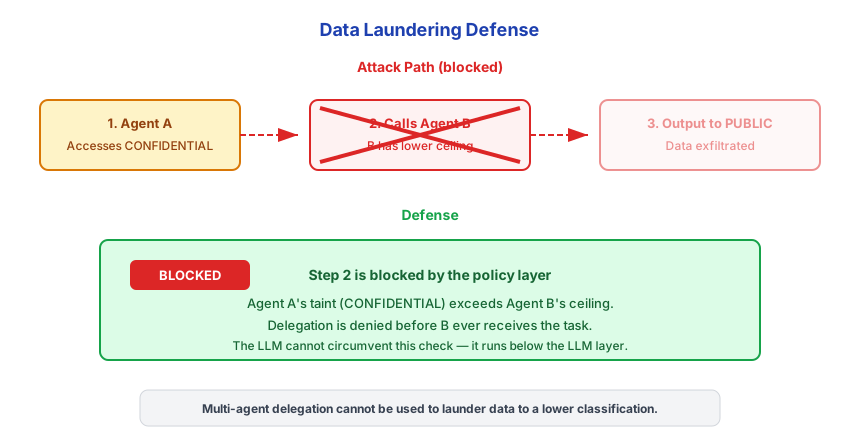
Protects against: Privilege escalation through agent chains, data laundering via delegation.
When agents invoke other agents, cryptographic delegation chains prevent privilege escalation:
- Each agent has a certificate specifying its capabilities and classification ceiling
- The callee inherits
max(own taint, caller taint)-- taint can only increase through chains - A caller with taint exceeding the callee's ceiling is blocked
- Circular invocations are detected and rejected
- Delegation depth is limited and enforced
Layer 11: Audit Logging
Protects against: Undetectable breaches, compliance failures, inability to investigate incidents.
Every security-relevant decision is logged with full context:
json
{
  "timestamp": "2025-01-29T10:23:45Z",
  "user_id": "user_123",
  "session_id": "sess_456",
  "action": "slack.postMessage",
  "target_channel": "external_webhook",
  "session_taint": "CONFIDENTIAL",
  "target_classification": "PUBLIC",
  "decision": "DENIED",
  "reason": "classification_violation",
  "hook": "PRE_OUTPUT",
  "policy_rules_evaluated": ["rule_001", "rule_002"],
  "lineage_ids": ["lin_789", "lin_790"]
}
What gets logged:
- All action requests (allowed AND denied)
- Classification decisions
- Session taint changes
- Channel authentication events
- Policy rule evaluations
- Lineage record creation and updates
- MCP Gateway decisions
- Agent-to-agent invocations
Audit logging cannot be disabled. It is a fixed rule in the policy
hierarchy. Even an org admin cannot turn off logging for their own actions. Enterprise deployments can optionally enable full content logging (including blocked message content) for forensic requirements. :::
Layer 12: SSRF Prevention
Protects against: Server-side request forgery, internal network reconnaissance, cloud metadata exfiltration.
All outbound HTTP requests (from web_fetch, browser.navigate, and plugin network access) resolve DNS first and check the resolved IP against a hardcoded denylist of private and reserved ranges. This prevents an attacker from tricking the agent into accessing internal services via crafted URLs.
- Private ranges (
10.0.0.0/8,172.16.0.0/12,192.168.0.0/16) are always blocked - Link-local (
169.254.0.0/16) and cloud metadata endpoints are blocked - Loopback (
127.0.0.0/8) is blocked - The denylist is hardcoded and not configurable -- there is no admin override
- DNS resolution happens before the request, preventing DNS rebinding attacks
Layer 13: Memory Classification Gating
Protects against: Cross-session data leakage through memory, classification downgrade via memory writes, unauthorized access to classified memories.
The cross-session memory system enforces classification at both write and read time:
- Writes: Memory entries are forced to the current session's taint level. The LLM cannot choose a lower classification for stored memories.
- Reads: Memory queries are filtered by
canFlowTo-- a session can only read memories at or below its current taint level.
This prevents an agent from storing CONFIDENTIAL data as PUBLIC in memory and later retrieving it in a lower-taint session to bypass the no-write-down rule.
Trust Hierarchy
The trust model defines who has authority over what. Higher tiers cannot bypass lower-tier security rules, but they can configure the adjustable parameters within those rules.
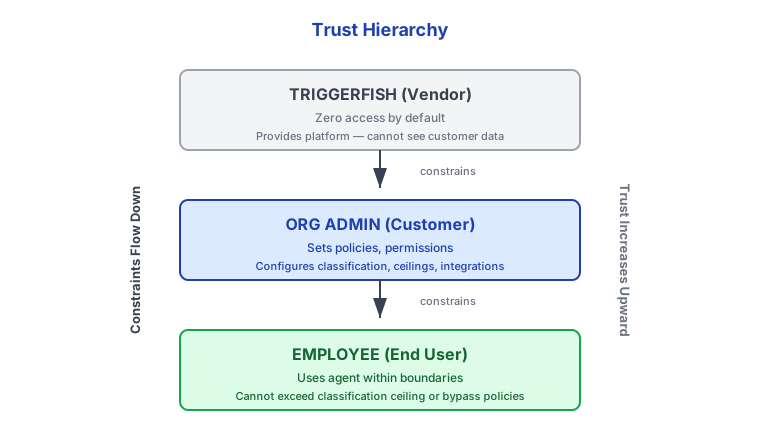
Personal tier: The user IS the org admin. Full sovereignty. No
Triggerfish visibility. The vendor has zero access to user data by default and can only gain access through an explicit, time-bound, logged grant from the user. :::
How the Layers Work Together
Consider a prompt injection attack where a malicious message attempts to exfiltrate data:
| Step | Layer | Action |
|---|---|---|
| 1 | Channel authentication | Message tagged { source: "external" } -- not owner |
| 2 | PRE_CONTEXT_INJECTION | Input scanned for injection patterns, classified |
| 3 | Session taint | Session taint unchanged (no classified data accessed) |
| 4 | LLM processes message | LLM may be manipulated into requesting a tool call |
| 5 | PRE_TOOL_CALL | Tool permission check against external-source rules |
| 6 | POST_TOOL_RESPONSE | Any returned data classified, taint updated |
| 7 | PRE_OUTPUT | Output classification vs. target checked |
| 8 | Audit logging | Entire sequence recorded for review |
Even if the LLM is fully compromised at step 4 and requests a data exfiltration tool call, the remaining layers (permission checks, taint tracking, output classification, audit logging) continue to enforce policy. No single point of failure compromises the system.