
Policy Engine & Hooks
The policy engine is the enforcement layer that sits between the LLM and the outside world. It intercepts every action at critical points in the data flow and makes deterministic ALLOW, BLOCK, or REDACT decisions. The LLM cannot bypass, modify, or influence these decisions.
Core Principle: Enforcement Below the LLM
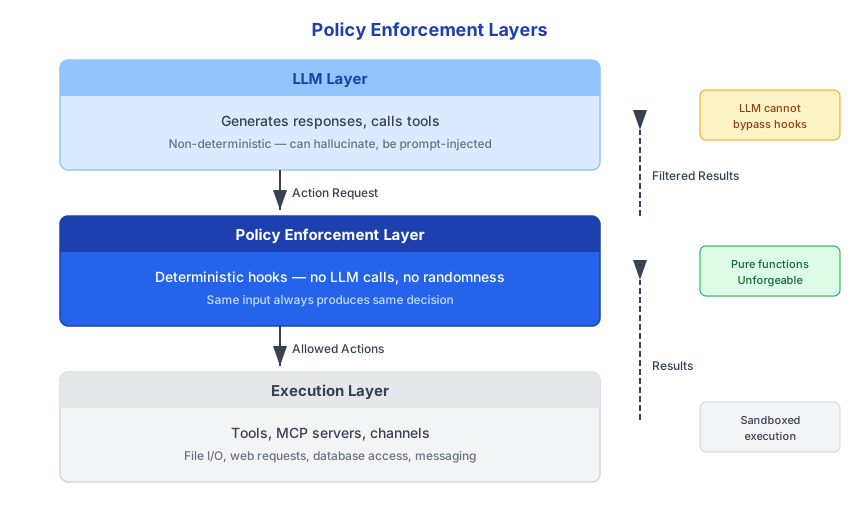
SECURITY The LLM sits above the policy layer. It can be
prompt-injected, jailbroken, or manipulated -- and it does not matter. The policy layer is pure code that runs below the LLM, examining structured action requests and making binary decisions based on classification rules. There is no pathway from LLM output to hook bypass. :::
Hook Types
Eight enforcement hooks intercept actions at every critical point in the data flow.
Hook Architecture
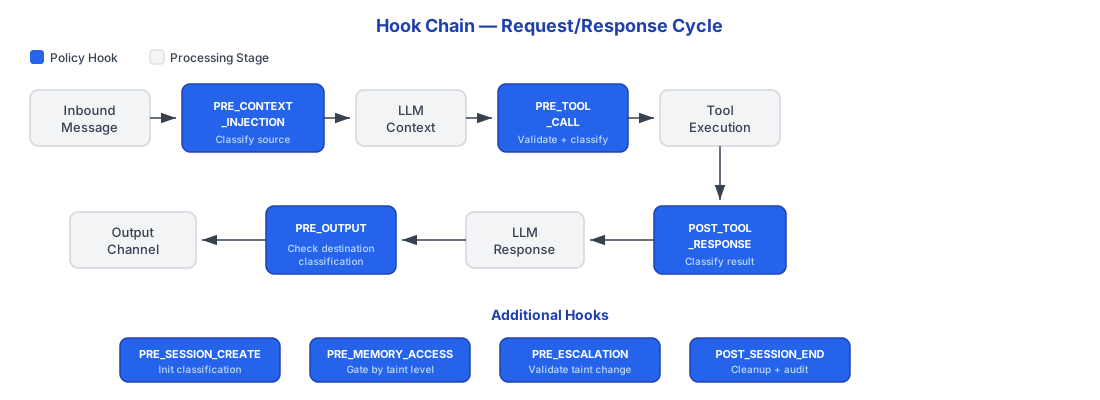
All Hook Types
| Hook | Trigger | Key Actions | Failure Mode |
|---|---|---|---|
PRE_CONTEXT_INJECTION | External input enters context | Classify input, assign taint, create lineage, scan for injection | Reject input |
PRE_TOOL_CALL | LLM requests tool execution | Permission check, rate limit, parameter validation | Block tool call |
POST_TOOL_RESPONSE | Tool returns data | Classify response, update session taint, create/update lineage | Redact or block |
PRE_OUTPUT | Response about to leave system | Final classification check against target, PII scan | Block output |
SECRET_ACCESS | Plugin requests a credential | Log access, verify permission against declared scope | Deny credential |
SESSION_RESET | User requests taint reset | Archive lineage, clear context, verify confirmation | Require confirmation |
AGENT_INVOCATION | Agent calls another agent | Verify delegation chain, enforce taint ceiling | Block invocation |
MCP_TOOL_CALL | MCP server tool invoked | Gateway policy check (server status, tool permissions, schema) | Block MCP call |
Hook Interface
Every hook receives a context and returns a result. The handler is a synchronous, pure function.
typescript
interface HookContext {
  readonly sessionId: SessionId;
  readonly hookType: HookType;
  readonly timestamp: Date;
  // Hook-specific payload varies by type
}

interface HookResult {
  readonly decision: "ALLOW" | "BLOCK" | "REDACT";
  readonly reason: string;
  readonly metadata?: Record<string, unknown>;
}

type HookHandler = (context: HookContext) => HookResult;
HookHandler is synchronous and returns HookResult directly -- not a
Promise. This is by design. Hooks must complete before the action proceeds, and making them synchronous eliminates any possibility of async bypass. If a hook times out, the action is rejected. :::
Hook Guarantees
Every hook execution carries four invariants:
| Guarantee | What it means |
|---|---|
| Deterministic | Same input always produces the same decision. No randomness. No LLM calls within hooks. No external API calls that affect decisions. |
| Synchronous | Hooks complete before the action proceeds. No async bypass is possible. Timeout equals rejection. |
| Logged | Every hook execution is recorded: input parameters, decision made, timestamp, and policy rules evaluated. |
| Unforgeable | LLM output cannot contain hook bypass instructions. The hook layer has no "parse LLM output for commands" logic. |
Policy Rules Hierarchy
Policy rules are organized into three tiers. Higher tiers cannot override lower tiers.
Fixed Rules (always enforced, NOT configurable)
These rules are hardcoded and cannot be disabled by any admin, user, or configuration:
- No write-down: Classification flow is one-directional. Data cannot flow to a lower level.
- UNTRUSTED channels: No data in or out. Period.
- Session taint: Once elevated, stays elevated for the session lifetime.
- Audit logging: All actions logged. No exceptions. No way to disable.
Configurable Rules (admin-tunable)
Administrators can adjust these through the UI or configuration files:
- Integration default classifications (e.g., Salesforce defaults to
CONFIDENTIAL) - Channel classifications
- Action allow/deny lists per integration
- Domain allowlists for external communications
- Rate limits per tool, per user, or per session
Declarative Escape Hatch (enterprise)
Enterprise deployments can define custom policy rules in structured YAML for advanced scenarios:
yaml
# Block any Salesforce query containing SSN patterns
hook: POST_TOOL_RESPONSE
conditions:
  - tool_name: salesforce.*
  - content_matches: '\b\d{3}-\d{2}-\d{4}\b'
action: REDACT
redaction_pattern: "[SSN REDACTED]"
log_level: ALERT
notify: security-team@company.com
yaml
# Require approval for high-value transactions
hook: PRE_TOOL_CALL
conditions:
  - tool_name: stripe.create_charge
  - parameter.amount: ">10000"
action: REQUIRE_APPROVAL
approvers:
  - role: finance-admin
timeout: 1h
timeout_action: DENY
yaml
# Time-based restriction: no external sends after hours
hook: PRE_OUTPUT
conditions:
  - recipient_type: EXTERNAL
  - time_of_day: "18:00-08:00"
  - day_of_week: "Mon-Fri"
action: BLOCK
reason: "External communications restricted outside business hours"
Custom YAML rules must pass validation before activation. Invalid rules
are rejected at configuration time, not at runtime. This prevents misconfiguration from creating security gaps. :::
Denial User Experience
When the policy engine blocks an action, the user sees a clear explanation -- not a generic error.
Default (specific):
I can't send confidential data to a public channel.

  -> Reset session and send message
  -> Cancel
Opt-in (educational):
I can't send confidential data to a public channel.

Why: This session accessed Salesforce (CONFIDENTIAL).
WhatsApp personal is classified as PUBLIC.
Data can only flow to equal or higher classification.

Options:
  -> Reset session and send message
  -> Ask your admin to reclassify the WhatsApp channel
  -> Learn more: [docs link]
The educational mode is opt-in and helps users understand why an action was blocked, including which data source caused the taint escalation and what the classification mismatch is. Both modes offer actionable next steps rather than dead-end errors.
How Hooks Chain Together
In a typical request/response cycle, multiple hooks fire in sequence. Each hook has full visibility into the decisions made by earlier hooks in the chain.
User sends: "Check my Salesforce pipeline and message my wife"

1. PRE_CONTEXT_INJECTION
   - Input from owner, classified as PUBLIC
   - Session taint: PUBLIC

2. PRE_TOOL_CALL (salesforce.query_opportunities)
   - Tool permitted? YES
   - User has Salesforce connection? YES
   - Rate limit? OK
   - Decision: ALLOW

3. POST_TOOL_RESPONSE (salesforce results)
   - Data classified: CONFIDENTIAL
   - Session taint escalates: PUBLIC -> CONFIDENTIAL
   - Lineage record created

4. PRE_TOOL_CALL (whatsapp.send_message)
   - Tool permitted? YES
   - Decision: ALLOW (tool-level check passes)

5. PRE_OUTPUT (message to wife via WhatsApp)
   - Session taint: CONFIDENTIAL
   - Target effective classification: PUBLIC (external recipient)
   - CONFIDENTIAL -> PUBLIC: BLOCKED
   - Decision: BLOCK
   - Reason: "classification_violation"

6. Agent presents reset option to user