
Zero trust AI security is the application of zero trust principles to artificial intelligence systems, requiring that every user, model, data source, and integration point is continuously verified and granted only the minimum access necessary to perform its function, with no implicit trust extended based on network location or prior authentication. It treats AI systems as high-value targets that require the same rigorous access controls as any other privileged infrastructure.
The traditional security perimeter model assumed that threats came from outside the network and that systems inside it could be trusted. That assumption was already under strain before AI arrived. AI deployments shatter it completely. An AI system connected to internal databases, email, document repositories, and external APIs operates across a trust boundary that a perimeter model cannot define, let alone defend. It accepts inputs from anywhere, retrieves content from multiple sources, and takes actions across connected systems in sequences that no traditional access control model was designed to govern. The attack surface is not a defined perimeter. It is the full set of connections an AI system can traverse, the full range of content it will process, and the full scope of actions it is authorized to take. Zero trust AI security addresses that reality by replacing the perimeter assumption with continuous verification across every interaction, every data access, and every action the AI system performs. This guide explains how zero trust principles apply specifically to AI deployments, what the seven pillars look like in an AI context, and what organizations need to build to make the model work in practice.

Why Perimeter Security Fails Specifically for AI Systems
The Connected AI Problem
A conventional enterprise application has a defined set of users, a defined set of functions, and a relatively predictable set of data access patterns. Security teams can build access controls around those definitions, monitor for deviations, and treat anomalies as signals of potential compromise. The predictability of behavior is what makes perimeter security workable even when imperfect.
AI systems, particularly agentic AI systems and those connected to retrieval pipelines, do not have predictable behavior in the same sense. Their responses vary with inputs. The data they access depends on what queries generate at runtime rather than on a predefined access list. The actions they take through connected tools depend on the tasks they are given rather than a fixed function set. Perimeter security built around a static definition of what the system does cannot keep pace with the dynamic reality of what it actually accesses and executes.
Prompt injection attacks exploit this gap directly. An attacker who can introduce malicious instructions into any content that an AI system retrieves or receives can potentially redirect the system's behavior entirely, causing it to access data, execute actions, or surface information in ways that bypass every perimeter control governing normal system behavior. The attack does not cross a network boundary. It crosses a trust boundary within the system's own processing, in a channel that perimeter defenses are not positioned to monitor.
Zero trust AI security addresses this by moving verification from the network perimeter to every individual interaction. Rather than asking whether a user or system is inside the trusted network, it asks whether this specific request, from this specific identity, for this specific resource, at this specific moment, is authorized. That question is asked continuously, not once at authentication.
How AI Amplifies the Consequences of Trust Violations
The reason zero trust AI security matters more than zero trust for conventional applications is not that AI systems are inherently less secure. It is that the consequences of a trust violation in a connected AI system are amplified by the system's connectivity and autonomy in ways that equivalent violations in conventional systems are not.
A compromised user account in a conventional application creates access to whatever that user can access. A compromised or manipulated AI agent with broad tool access can potentially traverse multiple connected systems, exfiltrate data from several sources, and take actions across multiple platforms in a single automated sequence that would require extensive attacker effort to replicate manually. The automation that makes AI agents valuable at legitimate tasks also makes them efficient at illegitimate ones when their behavior is manipulated or their access is exploited.
Zero trust AI security reduces the blast radius of trust violations by ensuring that even a successfully manipulated AI system can only access and affect the specific resources it has been granted permission for in the current context, rather than inheriting broad access that was granted at authentication and never revisited.
Reviewing how AI security architecture decisions around access scoping and continuous verification affect the practical blast radius of AI system compromise helps organizations build deployments where the consequences of security failures are bounded rather than unbounded.

The Seven Pillars of Zero Trust Applied to AI Systems
Zero trust security is organized around seven pillars that together define the complete verification and control architecture. Each pillar takes on specific characteristics and requirements when applied to AI systems rather than conventional applications.
Pillar One: Identity Verification
In conventional zero trust, identity verification covers human users and service accounts. In zero trust AI security, the identity surface expands to include the AI model itself as an identity that needs to be verified, the agents acting on behalf of users that need to be distinguished from those users for access control purposes, and the service accounts that AI systems use to access connected resources that need to be managed with the same rigor as human privileged accounts.
Continuous authentication rather than session-based authentication is the zero trust standard for human users accessing AI systems. Multi-factor authentication, behavioral analytics that monitor for anomalous usage patterns, and context-aware access policies that adjust verification requirements based on the sensitivity of what is being requested all apply in AI system deployments.
For AI agents operating autonomously, the identity challenge is maintaining the principle that the agent's access is scoped to the specific task it is performing rather than inheriting the full access of the human user who initiated it. An agent executing a research task on a user's behalf should have research access, not the user's complete access footprint. That scoping requires explicit identity architecture rather than the default inheritance that many agent frameworks implement.
Pillar Two: Device Security
Device security in a zero trust AI context covers both the endpoints from which users access AI systems and the infrastructure on which AI models run. For user devices, the standard zero trust controls apply, device health verification before access is granted, endpoint detection and response coverage, and access policies that vary based on device management status.
The infrastructure layer requires specific attention because AI inference hardware represents a high-value target that traditional endpoint security was not designed for. GPU servers running large models contain both the model weights, which represent significant intellectual property, and the data being processed through inference, which may include sensitive organizational information. The physical and logical security of AI inference infrastructure deserves the same privileged access management, integrity monitoring, and access logging as other high-value infrastructure assets.
Pillar Three: Network Segmentation
Zero trust network architecture replaces the flat trusted network with microsegmented zones where traffic between segments requires explicit authorization rather than flowing freely within the perimeter. For AI systems, network segmentation determines which components of the AI architecture can communicate with which others and which external resources the AI system can reach.
AI inference servers should be network-segmented from resources they do not need to access. A model serving customer service queries does not need network access to financial systems. A research AI tool does not need access to HR databases. The network architecture should enforce these separations rather than relying on AI system behavior to respect them voluntarily, because prompt injection and other manipulation techniques can potentially override behavioral restrictions while network segmentation enforces them physically.
External network access for AI systems, including access to web search, external APIs, and cloud services, should be explicitly permitted through allowlists rather than permitted by default with exceptions blocked. The default for AI system external connectivity in a zero trust architecture is no access, with specific permitted destinations added based on documented operational requirements.
Pillar Four: Application Security
Application security in the zero trust AI context covers the security of the AI application layer itself, including the prompting infrastructure, the retrieval pipelines, the tool integrations, and the output handling logic that together define how the AI system processes requests and produces responses.
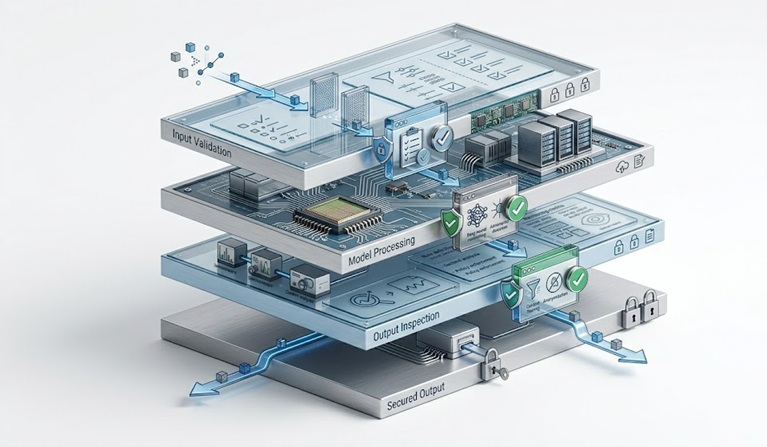
Input validation and sanitization at the application layer represents the zero trust principle of verifying content, not just identity, applied to AI systems. Every input that reaches the model, whether from users, retrieved documents, tool outputs, or system messages, should be treated as potentially adversarial and processed through appropriate filtering rather than implicitly trusted.
Output validation applies the same principle in reverse. Every output the AI system produces before it reaches users, connected systems, or downstream processes should be inspected against defined criteria that detect harmful content, sensitive data leakage, and behavioral anomalies that suggest the model has been manipulated.
Understanding how AI architecture decisions at the application layer affect the practical implementation of zero trust input and output controls helps organizations build AI systems where security is embedded in the processing pipeline rather than bolted on at the perimeter.
Pillar Five: Data Security
Data security under zero trust AI requires treating every data access by an AI system as requiring explicit authorization rather than inheriting broad permissions. This pillar is where AI deployments most directly require purpose-built zero trust controls because existing data security architectures were not designed for the dynamic, query-driven data access patterns that AI retrieval systems create.
Data classification that AI systems respect in their retrieval and processing behavior requires integration between the data governance infrastructure and the AI access control layer. When a user's authorization level determines which documents they can directly access in a document management system, the AI system retrieving documents on that user's behalf should respect the same authorization boundary, returning only documents the user is authorized to see rather than everything in the knowledge base that is relevant to their query.
Data minimization, a core zero trust data principle, requires that AI systems access and process only the specific data necessary for the current task. An AI assistant asked to draft an email response does not need access to the full customer history. An AI tool summarizing a specific document does not need access to the surrounding folder. Implementing data minimization in AI systems requires access controls that operate at the granular data level rather than at the system or database level.
Reviewing how AI features in enterprise AI platforms implement data access controls and retrieval authorization helps organizations evaluate whether a vendor's data security architecture supports zero trust principles or requires supplementary controls to achieve the same effect.
Pillar Six: Visibility and Analytics
Zero trust security is predicated on the ability to detect anomalies that indicate trust violations, which requires comprehensive visibility into everything the AI system does. Without logging and monitoring coverage across every AI system interaction, zero trust verification produces no signal when violations occur because the evidence required to detect them does not exist.
For AI systems, visibility requirements extend beyond conventional application logging. Every query submitted to the model, every document retrieved through RAG pipelines, every tool call executed by an agent, every output produced by the system, and every access control decision made at each verification checkpoint needs to be captured in logs that security operations teams can monitor and investigate.
Behavioral analytics applied to AI system activity logs create the anomaly detection capability that makes zero trust visibility actionable. Baseline models of normal AI system behavior, including typical query patterns, usual retrieval volumes, and standard tool usage frequencies, enable detection of deviations that may indicate prompt injection, data exfiltration attempts, or unauthorized access patterns that would be invisible without behavioral reference points.
Pillar Seven: Automation and Orchestration
Zero trust at enterprise scale cannot be operated manually. The verification decisions, the anomaly responses, and the access policy updates that continuous verification requires happen at a frequency and across a system complexity that human operation cannot match. Automation and orchestration, the final zero trust pillar, covers the systems that make zero trust operational at scale rather than theoretical in architecture documents.
For AI systems specifically, automated response to detected anomalies, including rate limiting triggered by unusual query patterns, access restriction triggered by behavioral anomalies, and alert escalation triggered by potential prompt injection signatures, provides the response speed that makes zero trust detection meaningful. Detection without automated response creates a system that identifies threats faster than humans can act on them.
| Zero Trust Pillar | Conventional Application | AI System Specific Extension |
|---|---|---|
| Identity | User and service account verification | Plus AI agent identity, scoped task credentials |
| Device | Endpoint health and management status | Plus AI inference infrastructure integrity |
| Network | Microsegmentation between zones | Plus AI-specific allowlists for external access |
| Application | Input validation and output monitoring | Plus prompt injection detection, output filtering |
| Data | Classification-based access control | Plus retrieval authorization, data minimization in queries |
| Visibility | Application and access logs | Plus model query, retrieval, tool call, and output logs |
| Automation | Policy enforcement and anomaly response | Plus AI-specific behavioral analytics and response |
Building Zero Trust AI Security in Practice
Starting With an Access Audit
The practical starting point for zero trust AI security is an honest audit of what each AI system in the organization's deployment can currently access versus what it actually needs to access for its defined function. The gap between those two inventories defines the least privilege remediation work that brings the deployment closer to zero trust principles.
Most AI systems, particularly those that have evolved through iterative integration work, have accumulated access permissions that reflect the history of what was connected rather than a deliberate assessment of what is necessary. A research AI tool that was integrated with email to retrieve referenced documents, then connected to the document management system for broader context, then linked to the CRM for customer reference, may now have access across three systems that each contain sensitive data well beyond what any specific research task requires.
The access audit produces a capability map, every system an AI tool can access, every action it can take, and every data category it can retrieve, alongside an operational requirements map, every system it actually needs for its defined function, every action that function legitimately requires, and every data category the function genuinely needs. The remediation is closing the gap between the two through access scope reduction, network segmentation, and the deployment of just-in-time access patterns for capabilities the system needs occasionally rather than continuously.
Implementing Continuous Verification Without Degrading Performance
A common concern about applying zero trust principles to AI systems is that continuous verification will introduce latency that degrades the user experience of AI tools that need to respond quickly. This concern is real but manageable through architecture choices that locate verification at the right points rather than adding it uniformly to every interaction.
Session-level verification for authenticated user access handles the majority of human identity verification overhead with a single authentication event rather than per-query. Cached authorization decisions for data access patterns that recur frequently reduce the verification overhead for retrieval operations without abandoning the verification requirement. Asynchronous verification for lower-sensitivity operations that can tolerate slightly delayed authorization resolution preserves the zero trust audit trail without synchronous latency on every interaction.
The verification points that genuinely require synchronous blocking behavior before proceeding are those governing high-sensitivity data access, actions with significant or irreversible consequences, and behavioral anomalies that trigger elevated scrutiny. For routine operations within established behavioral baselines, verification can be efficiently handled without user-visible latency through well-designed caching and asynchronous architectures.
A comprehensive AI guide on implementing zero trust AI security architectures that balance verification rigor with operational performance helps organizations avoid the false choice between security and usability that poorly designed implementations create.
IMAGE SUGGESTION: A developer or security architect at a dual-monitor workstation reviewing access control configuration settings for an AI system deployment, organized technical environment, code or configuration visible on one screen and a system diagram on the other, no readable text visible on either screen.
Things To Know
Several important realities about zero trust AI security that organizations encounter as they move from architecture principles to operational implementation:
Zero trust is a continuous process, not a deployment state. Organizations do not achieve zero trust and maintain it passively. They continuously move toward zero trust through ongoing access scope reduction, monitoring coverage expansion, and verification architecture improvement. The goal is directional and ongoing rather than a defined completion state.
Legacy AI integrations are the hardest zero trust remediation target. AI systems that were integrated with existing infrastructure before zero trust principles were applied to the deployment often have access patterns that are technically difficult to scope without breaking functionality. Remediating these integrations requires understanding both the zero trust requirement and the operational dependency, which often means working through integrations one by one rather than applying a uniform policy change.
The 30% principle applies to zero trust verification automation. Automated verification controls should handle approximately 30% of security operations, specifically the high-frequency, policy-based access decisions and behavioral monitoring that automation executes consistently at scale. Security professionals and governance owners handle the remaining 70% involving risk assessment, policy design, anomaly investigation, and the judgment-intensive security decisions that require human accountability rather than algorithmic execution.
Zero trust does not eliminate the need for perimeter security. It layers with perimeter controls rather than replacing them. Organizations moving to zero trust AI security maintain network perimeter controls while adding the identity, data, and behavioral verification layers that zero trust provides. The perimeter becomes one layer among many rather than the primary defense.
User experience impacts of zero trust implementation determine adoption success. Security architectures that make AI tools significantly more cumbersome to use drive employees toward shadow AI alternatives that operate outside any zero trust controls. Designing verification flows that are minimally intrusive for legitimate usage while maintaining rigorous controls for anomalous or high-risk operations is an implementation quality requirement, not an optional enhancement.
Vendor zero trust support varies significantly across enterprise AI platforms. Some enterprise AI tools are designed with zero trust integration points including identity federation, granular access controls, comprehensive logging APIs, and behavioral monitoring support. Others require significant supplementary infrastructure to achieve equivalent zero trust coverage. Evaluating vendor zero trust support as part of AI tool selection reduces the implementation burden relative to retrofitting zero trust controls onto tools that were not designed for them.
Joint accountability between security and AI operations teams is essential for zero trust AI security programs that work in practice. Security teams bring the zero trust expertise. AI operations teams bring the understanding of AI system behavior, integration dependencies, and operational requirements that determines where verification controls are practical and where they require architectural workarounds. Programs designed by security teams without AI operations input tend to create theoretical security architectures that fail in deployment.
Zero Trust as the Right Foundation for Confident AI Deployment
Zero trust AI security is not the most convenient security architecture for AI systems. It requires more deliberate access design, more investment in verification infrastructure, and more operational discipline than perimeter security or implicit trust models. Organizations that make that investment consistently find that it enables rather than constrains their AI ambitions because it creates the security foundation that allows AI systems to be connected more broadly, trusted more deeply, and deployed in higher-stakes contexts than systems operating without equivalent verification rigor.
The AI systems that will ultimately carry the most organizational value are those trusted with the most sensitive data, connected to the most consequential systems, and authorized to take the most impactful actions. Zero trust AI security is the architecture that makes that trust defensible rather than aspirational, providing the continuous verification, behavioral visibility, and access scoping that allows organizations to extend meaningful trust to AI systems rather than accepting exposure as the cost of capability.
Frequently Asked Questions
What is Zero Trust in AI?
Zero trust in AI is the application of continuous verification and least privilege access principles to artificial intelligence systems, requiring that every user, model, agent, data access, and tool interaction is verified against current authorization rather than relying on implicit trust granted at initial authentication or based on network location. It treats AI systems as high-value targets with dynamic, connected behavior that requires verification architecture specifically designed for how AI systems actually operate rather than conventional application security models that do not account for AI-specific attack surfaces.
What is zero trust security?
Zero trust security is a security model built on the principle that no user, device, or system should be implicitly trusted based on its network location, requiring instead that every access request is continuously verified against identity, device health, and contextual authorization policies before access is granted. It replaces the traditional perimeter model that trusted everything inside the network boundary with a model that treats every interaction as potentially untrusted and requires verification at every access point regardless of where the request originates.
What is an example of zero trust security model?
A practical example of a zero trust security model in an AI deployment is an enterprise AI assistant where every user authenticates with multi-factor authentication before accessing the system, the AI's retrieval pipeline enforces the requesting user's document permissions so it can only surface content they are authorized to see, all tool calls the AI agent makes require explicit per-action authorization rather than inheriting broad service account permissions, and every query, retrieval, and action is logged for behavioral monitoring that flags anomalies for security review. This example illustrates zero trust applied across the identity, data, and action dimensions of an AI system rather than only at the network perimeter.
How does Zero Trust improve security?
Zero trust improves security by reducing the blast radius of successful attacks through least privilege access scoping that limits what a compromised identity or manipulated AI system can access, by enabling faster anomaly detection through comprehensive logging of all access events against behavioral baselines, and by eliminating the implicit trust assumptions that attackers exploit through lateral movement once they are inside a network perimeter. For AI systems specifically, zero trust improves security by applying continuous verification to the dynamic, connected behavior of AI agents that perimeter defenses cannot govern because it has no defined boundary to protect.
What are the 7 pillars of Zero Trust?
The seven pillars of zero trust are identity verification requiring continuous authentication of users and systems, device security ensuring endpoint health before access is granted, network segmentation replacing the flat trusted network with microsegmented zones requiring explicit authorization between them, application security applying input validation and output monitoring at the application layer, data security enforcing classification-based access controls and data minimization, visibility and analytics providing comprehensive logging and behavioral anomaly detection, and automation and orchestration enabling policy enforcement and anomaly response at the scale and speed that continuous verification requires. Applied to AI systems, each pillar takes on specific extensions that address the unique characteristics of AI behavior, connectivity, and attack surface that conventional application security was not designed to govern.