
GitHub Integration
Triggerfish integrates with GitHub through two complementary approaches:
Quick Setup: REST API Tools
The fastest way to connect GitHub. Gives the agent 14 built-in tools for repos, PRs, issues, Actions, and code search -- all with classification-aware taint propagation.
bash
triggerfish connect githubThis walks you through creating a fine-grained Personal Access Token, validates it, and stores it in the OS keychain. That's it -- your agent can now use all github_* tools.
See the Skills documentation for more on how skills work, or run triggerfish skills list to see all available tools.
Advanced: gh CLI + Webhooks
For the full development feedback loop (agent creates branches, opens PRs, responds to code review), Triggerfish also supports the gh CLI via exec and webhook-driven review delivery. This uses three composable pieces:
ghCLI via exec -- perform all GitHub actions (create PRs, read reviews, comment, merge)- Review delivery -- two modes: webhook events (instant, requires public endpoint) or trigger-based polling via
gh pr view(works behind firewalls) - git-branch-management skill -- teaches the agent the complete branch/PR/review workflow
Together, these create a full development feedback loop: the agent creates branches, commits code, opens PRs, and responds to reviewer feedback -- no custom GitHub API code required.
Prerequisites
gh CLI
The GitHub CLI (gh) must be installed and authenticated in the environment where Triggerfish runs.
bash
# Install gh (Fedora/RHEL)
sudo dnf install gh

# Install gh (macOS)
brew install gh

# Install gh (Debian/Ubuntu)
sudo apt install gh

# Authenticate
gh auth login
Verify authentication:
bash
gh auth statusThe agent uses gh via exec.run("gh ...") -- no separate GitHub token configuration is needed beyond the gh login.
Git
Git must be installed and configured with a user name and email:
bash
git config --global user.name "Triggerfish Agent"
git config --global user.email "triggerfish@example.com"
Repository Access
The agent's workspace must be a git repository (or contain one) with push access to the remote.
Review Delivery
There are two ways for the agent to learn about new PR reviews. Choose one or use both together.
Option A: Trigger-Based Polling
No inbound connectivity required. The agent polls GitHub on a schedule using gh pr view. Works behind any firewall, NAT, or VPN.
Add a cron job to triggerfish.yaml:
yaml
scheduler:
  cron:
    jobs:
      - id: pr-review-check
        schedule: "*/15 * * * *"
        task: >
          Check all open PR tracking files in scratch/pr-tracking/.
          For each open PR, query GitHub for new reviews or state changes
          using gh pr view. Address any review feedback, handle merges
          and closures.
        classification: INTERNAL
Or add "check open PRs for review feedback" to the agent's TRIGGER.md for execution during the regular trigger wakeup cycle.
Option B: Webhook Setup
Webhooks deliver review events instantly. This requires the Triggerfish gateway to be reachable from GitHub's servers (e.g. via Tailscale Funnel, reverse proxy, or tunnel).
Step 1: Generate a webhook secret
bash
openssl rand -hex 32Store this as an environment variable:
bash
export GITHUB_WEBHOOK_SECRET="<generated-secret>"Add it to your shell profile or secrets manager so it persists across restarts.
Step 2: Configure Triggerfish
Add the webhook endpoint to triggerfish.yaml:
yaml
webhooks:
  endpoints:
    - id: github
      path: /webhook/github
      # secret stored in OS keychain
      classification: INTERNAL
      actions:
        - event: "pull_request_review"
          task: >
            A PR review was submitted. Read the PR tracking file from
            scratch/pr-tracking/ to recover context. Check out the branch,
            read the review, address any requested changes, commit, push,
            and comment on the PR with a summary of changes made.
        - event: "pull_request_review_comment"
          task: >
            An inline review comment was posted on a PR. Read the PR
            tracking file, check out the branch, address the specific
            comment, commit, push.
        - event: "issue_comment"
          task: >
            A comment was posted on a PR or issue. Check if this is a
            tracked PR by looking up tracking files in scratch/pr-tracking/.
            If tracked, check out the branch and address the feedback.
        - event: "pull_request.closed"
          task: >
            A PR was closed or merged. Read the tracking file. If merged,
            clean up: delete local branch, archive tracking file to
            completed/. Notify the owner of the merge. If closed without
            merge, archive and notify.
Step 3: Expose the webhook endpoint
Triggerfish's gateway must be reachable from GitHub's servers. Options:
Tailscale Funnel (recommended for personal use):
yaml
# In triggerfish.yaml
remote:
  tailscale:
    serve: true
    funnel:
      enabled: true
      paths: ["/webhook/*"]
This exposes https://<your-machine>.ts.net/webhook/github to the internet.
Reverse proxy (nginx, Caddy):
Forward /webhook/github to your gateway's local port.
ngrok (development/testing):
bash
ngrok http 8080Use the generated URL as the webhook target.
Step 4: Configure the GitHub webhook
In your GitHub repository (or organization):
- Go to Settings > Webhooks > Add webhook
- Set the Payload URL to your exposed endpoint:
https://<your-host>/webhook/github - Set Content type to
application/json - Set Secret to the same value as
GITHUB_WEBHOOK_SECRET - Under Which events would you like to trigger this webhook?, select Let me select individual events and check:
- Pull requests (covers
pull_request.opened,pull_request.closed) - Pull request reviews (covers
pull_request_review) - Pull request review comments (covers
pull_request_review_comment) - Issue comments (covers
issue_commenton PRs and issues)
- Pull requests (covers
- Click Add webhook
GitHub will send a ping event to verify the connection. Check Triggerfish logs to confirm receipt:
bash
triggerfish logs --tailHow the Feedback Loop Works
With webhooks (instant)
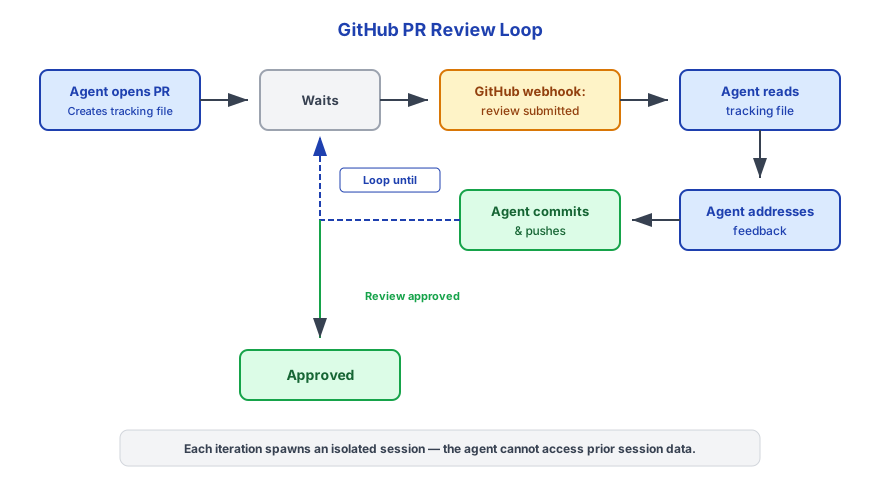
With trigger-based polling (behind firewall)
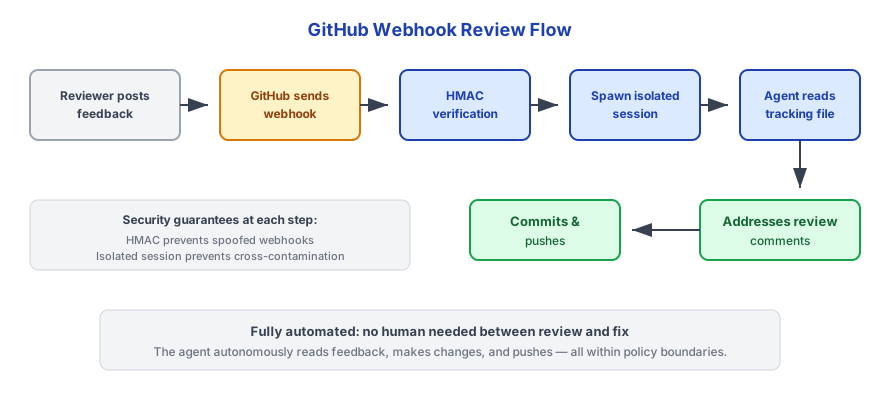
Both paths use the same tracking files. The agent recovers context by reading the PR tracking file from ~/.triggerfish/workspace/<agent-id>/scratch/pr-tracking/.
PR Tracking Files
The agent writes a tracking file for each PR it creates:
~/.triggerfish/workspace/<agent-id>/scratch/pr-tracking/<branch-name>.jsonSchema:
json
{
  "branch": "triggerfish/agent-1/fix-auth-timeout",
  "prNumber": 42,
  "prUrl": "https://github.com/owner/repo/pull/42",
  "task": "Fix authentication timeout when token expires during long requests",
  "repository": "owner/repo",
  "createdAt": "2025-01-15T10:30:00Z",
  "updatedAt": "2025-01-15T10:30:00Z",
  "lastCheckedAt": "2025-01-15T10:30:00Z",
  "lastReviewId": "",
  "status": "open",
  "commits": [
    "feat: add token refresh before expiry",
    "test: add timeout edge case coverage"
  ]
}
After merge, tracking files are archived to completed/.
Merge Policy
By default, the agent does not auto-merge approved PRs. When a review is approved, the agent notifies the owner and waits for an explicit merge instruction.
To enable auto-merge, add to triggerfish.yaml:
yaml
github:
  auto_merge: true
When enabled, the agent will run gh pr merge --squash --delete-branch after receiving an approving review.
Auto-merge is disabled by default for safety. Only enable it if you
trust the agent's changes and have branch protection rules (required reviewers, CI checks) configured in GitHub. :::
Optional: GitHub MCP Server
For richer GitHub API access beyond what gh CLI and the built-in tools provide, you can also configure the GitHub MCP server:
yaml
mcp_servers:
  - id: github
    command: "npx"
    args: ["-y", "@modelcontextprotocol/server-github"]
    # GitHub token is read from the OS keychain
    classification: CONFIDENTIAL
This is not required for most workflows -- the built-in github_* tools (set up via triggerfish connect github) and gh CLI cover all common operations. The MCP server is useful for advanced queries not covered by the built-in tools.
Security Considerations
| Control | Detail |
|---|---|
| HMAC verification | All GitHub webhooks are verified with HMAC-SHA256 before processing (webhook mode) |
| Classification | GitHub data is classified as INTERNAL by default -- code and PR data do not leak to public channels |
| Session isolation | Each webhook event or trigger wakeup spawns a fresh isolated session |
| No Write-Down | Agent responses to INTERNAL-classified PR events cannot be sent to PUBLIC channels |
| Credential handling | gh CLI manages its own auth token; no GitHub tokens stored in triggerfish.yaml |
| Branch naming | triggerfish/ prefix makes agent branches easily identifiable and filterable |
If your repository contains sensitive code (proprietary,
security-critical), consider setting the webhook classification to CONFIDENTIAL instead of INTERNAL. :::
Troubleshooting
Webhook not receiving events
- Check that the webhook URL is reachable from the internet (use
curlfrom an external machine) - In GitHub, go to Settings > Webhooks and check the Recent Deliveries tab for errors
- Verify the secret matches between GitHub and
GITHUB_WEBHOOK_SECRET - Check Triggerfish logs:
triggerfish logs --tail
PR reviews not being picked up (polling mode)
- Check that the
pr-review-checkcron job is configured intriggerfish.yaml - Verify the daemon is running:
triggerfish status - Check that tracking files exist in
~/.triggerfish/workspace/<agent-id>/scratch/pr-tracking/ - Test manually:
gh pr view <number> --json reviews - Check Triggerfish logs:
triggerfish logs --tail
gh CLI not authenticated
bash
gh auth status
# If not authenticated:
gh auth login
Agent cannot push to remote
Verify git remote and credentials:
bash
git remote -v
gh auth status
Ensure the authenticated GitHub account has push access to the repository.
Tracking file not found during review
The agent looks for tracking files in ~/.triggerfish/workspace/<agent-id>/scratch/pr-tracking/. If the file is missing, the PR may have been created outside Triggerfish, or the workspace was cleaned. The agent should notify the owner and skip automated handling.