
Webhooks
Triggerfish can accept inbound events from external services, enabling real-time reactions to emails, error alerts, CI/CD events, calendar changes, and more. Webhooks turn your agent from a reactive question-answering system into a proactive participant in your workflows.
How Webhooks Work
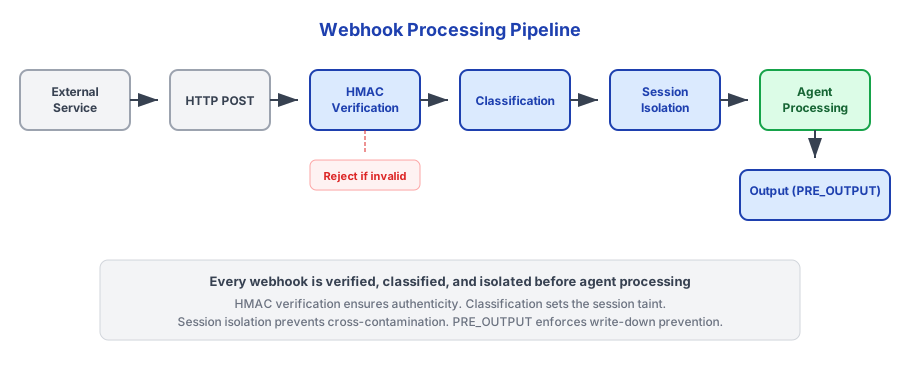
External services send HTTP POST requests to registered webhook endpoints on the Triggerfish gateway. Each incoming event is verified for authenticity, classified, and routed to the agent for processing.
Supported Event Sources
Triggerfish can receive webhooks from any service that supports HTTP webhook delivery. Common integrations include:
| Source | Mechanism | Example Events |
|---|---|---|
| Gmail | Pub/Sub push notifications | New email, label change |
| GitHub | Webhook | PR opened, issue comment, CI failure |
| Sentry | Webhook | Error alert, regression detected |
| Stripe | Webhook | Payment received, subscription change |
| Calendar | Polling or push | Event reminder, conflict detected |
| Custom | Generic webhook endpoint | Any JSON payload |
Configuration
Webhook endpoints are configured in triggerfish.yaml:
yaml
webhooks:
  endpoints:
    - id: github-events
      path: /webhook/github
      # secret stored in OS keychain
      classification: INTERNAL
      actions:
        - event: "pull_request.opened"
          task: "Review PR and post summary"
        - event: "issues.opened"
          task: "Triage new issue"

    - id: sentry-alerts
      path: /webhook/sentry
      # secret stored in OS keychain
      classification: CONFIDENTIAL
      actions:
        - event: "error"
          task: "Investigate error and create fix PR if possible"

    - id: stripe-payments
      path: /webhook/stripe
      # secret stored in OS keychain
      classification: CONFIDENTIAL
      actions:
        - event: "payment_intent.succeeded"
          task: "Log payment and update customer record"
        - event: "charge.failed"
          task: "Alert owner about failed charge"
Configuration Fields
| Field | Required | Description |
|---|---|---|
id | Yes | Unique identifier for this webhook endpoint |
path | Yes | URL path where the endpoint is registered |
secret | Yes | Shared secret for HMAC signature verification |
classification | Yes | Classification level assigned to events from this source |
actions | Yes | List of event-to-task mappings |
actions[].event | Yes | Event type pattern to match |
actions[].task | Yes | Natural language task for the agent to execute |
Webhook secrets are stored in the OS keychain. Run triggerfish dive or
configure webhooks interactively to enter them securely. :::
HMAC Signature Verification
Every inbound webhook request is verified for authenticity using HMAC signature validation before the payload is processed.
How Verification Works
- External service sends a webhook with a signature header (for example,
X-Hub-Signature-256for GitHub) - Triggerfish computes the HMAC of the request body using the configured shared secret
- The computed signature is compared against the signature in the request header
- If the signatures do not match, the request is rejected immediately
- If verified, the payload proceeds to classification and processing
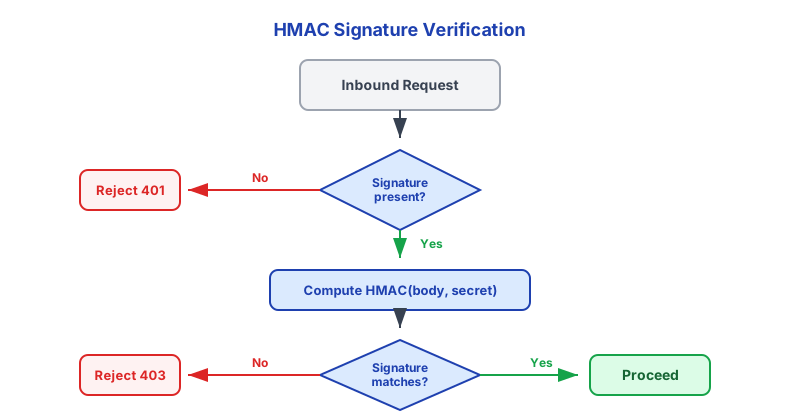
SECURITY Webhook requests without valid HMAC signatures are rejected
before any processing occurs. This prevents spoofed events from triggering agent actions. Never disable signature verification in production. :::
Event Processing Pipeline
Once a webhook event passes signature verification, it flows through the standard security pipeline:
1. Classification
The event payload is classified at the level configured for the webhook endpoint. A webhook endpoint configured as CONFIDENTIAL produces CONFIDENTIAL events.
2. Session Isolation
Each webhook event spawns its own isolated session. This means:
- The event is processed independently of any ongoing conversations
- Session taint starts fresh (at the webhook's classification level)
- No data leaks between webhook-triggered sessions and user sessions
- Each session gets its own taint tracking and lineage
3. PRE_CONTEXT_INJECTION Hook
The event payload passes through the PRE_CONTEXT_INJECTION hook before entering the agent context. This hook:
- Validates the payload structure
- Applies classification to all data fields
- Creates a lineage record for the inbound data
- Scans for injection patterns in string fields
- Can block the event if policy rules dictate
4. Agent Processing
The agent receives the classified event and executes the configured task. The task is a natural language instruction -- the agent uses its full capabilities (tools, skills, browser, exec environment) to complete it within policy constraints.
5. Output Delivery
Any output from the agent (messages, notifications, actions) passes through the PRE_OUTPUT hook. The No Write-Down rule applies: output from a CONFIDENTIAL webhook-triggered session cannot be sent to a PUBLIC channel.
6. Audit
The complete event lifecycle is logged: receipt, verification, classification, session creation, agent actions, and output decisions.
Integration with the Scheduler
Webhooks integrate naturally with Triggerfish's cron and trigger system. A webhook event can:
- Trigger an existing cron job ahead of schedule (for example, a deployment webhook triggers an immediate health check)
- Create a new scheduled task (for example, a calendar webhook schedules a reminder)
- Update trigger priorities (for example, a Sentry alert makes the agent prioritize error investigation on its next trigger wakeup)
yaml
webhooks:
  endpoints:
    - id: deploy-notify
      path: /webhook/deploy
      # secret stored in OS keychain
      classification: INTERNAL
      actions:
        - event: "deployment.completed"
          task: "Run health check on the deployed service and report results"
          # Agent may use cron.create to schedule follow-up checks
Security Summary
| Control | Description |
|---|---|
| HMAC verification | All inbound webhooks verified before processing |
| Classification | Webhook payloads classified at the configured level |
| Session isolation | Each event gets its own isolated session |
PRE_CONTEXT_INJECTION | Payload scanned and classified before entering context |
| No Write-Down | Output from high-classification events cannot reach low-classification channels |
| Audit logging | Complete event lifecycle recorded |
| Not publicly exposed | Webhook endpoints are not exposed to the public internet by default |
Example: GitHub PR Review Loop
A real-world example of webhooks in action: the agent opens a PR, then GitHub webhook events drive the code review feedback loop without any polling.
How It Works
- The agent creates a feature branch, commits code, and opens a PR via
gh pr create - The agent writes a tracking file to
~/.triggerfish/workspace/<agent-id>/scratch/pr-tracking/with the branch name, PR number, and task context - The agent stops and waits -- no polling
When a reviewer posts feedback:
- GitHub sends a
pull_request_reviewwebhook to Triggerfish - Triggerfish verifies the HMAC signature, classifies the event, and spawns an isolated session
- The agent reads the tracking file to recover context, checks out the branch, addresses the review, commits, pushes, and comments on the PR
- Steps 4-6 repeat until the review is approved
When the PR is merged:
- GitHub sends a
pull_request.closedwebhook withmerged: true - The agent cleans up: deletes the local branch, archives the tracking file
Configuration
yaml
webhooks:
  endpoints:
    - id: github
      path: /webhook/github
      # secret stored in OS keychain
      classification: INTERNAL
      actions:
        - event: "pull_request_review"
          task: "A PR review was submitted. Read the tracking file, address feedback, commit, push."
        - event: "pull_request_review_comment"
          task: "An inline review comment was posted. Read the tracking file, address the comment."
        - event: "issue_comment"
          task: "A comment was posted on a PR. If tracked, address the feedback."
        - event: "pull_request.closed"
          task: "A PR was closed or merged. Clean up branches and archive tracking file."
The GitHub webhook must send: Pull requests, Pull request reviews, Pull request review comments, and Issue comments.
See the full GitHub Integration guide for setup instructions and the git-branch-management bundled skill for the complete agent workflow.
Enterprise Controls
- Webhook allowlist managed by admin -- only approved external sources can register endpoints
- Rate limiting per endpoint to prevent abuse
- Payload size limits to prevent memory exhaustion
- IP allowlisting for additional source verification
- Retention policies for webhook event logs
Webhook endpoints are not exposed to the public internet by default.
For external services to reach your Triggerfish instance, you need to configure port forwarding, a reverse proxy, or a tunnel. The Remote Access section of the docs covers secure exposure options. :::