
Voice Pipeline
The STT and TTS providers listed below are interface-only stubs. The
provider interfaces are defined but the implementations are not yet connected to actual speech services. :::
Triggerfish supports speech interaction with wake word detection, push-to-talk, and text-to-speech response across macOS, iOS, and Android.
Architecture
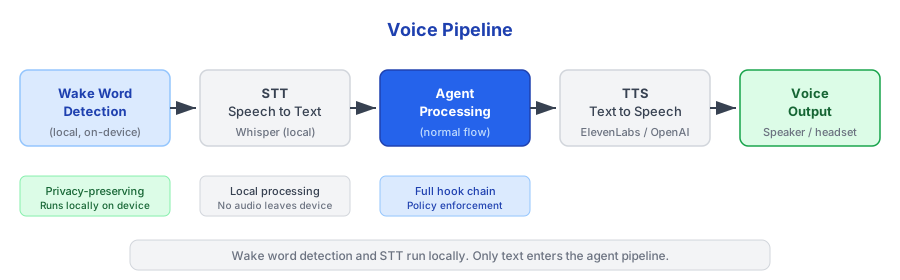
Audio flows through the same agent processing pipeline as text. Voice input is transcribed, enters the session as a classified message, passes through policy hooks, and the response is synthesized back to speech.
Voice Modes
| Mode | Description | Platform |
|---|---|---|
| Voice Wake | Always-on listening for a configurable wake word | macOS, iOS, Android |
| Push-to-Talk | Manual activation via button or keyboard shortcut | macOS (menu bar), iOS, Android |
| Talk Mode | Continuous conversational speech | All platforms |
STT Providers
Speech-to-text converts your voice into text for the agent to process.
| Provider | Type | Notes |
|---|---|---|
| Whisper | Local | Default. Runs on-device, no cloud dependency. Best for privacy. |
| Deepgram | Cloud | Low-latency streaming transcription. |
| OpenAI Whisper API | Cloud | High accuracy, requires API key. |
TTS Providers
Text-to-speech converts agent responses into spoken audio.
| Provider | Type | Notes |
|---|---|---|
| ElevenLabs | Cloud | Default. Natural-sounding voices with voice cloning options. |
| OpenAI TTS | Cloud | High quality, multiple voice options. |
| System Voices | Local | OS-native voices. No cloud dependency. |
Provider Registry
Triggerfish uses a provider registry pattern for both STT and TTS. You can plug in any compatible provider by implementing the corresponding interface:
typescript
interface SttProvider {
  transcribe(audio: Uint8Array, options?: SttOptions): Promise<string>;
}

interface TtsProvider {
  synthesize(text: string, options?: TtsOptions): Promise<Uint8Array>;
}
Configuration
Configure voice settings in triggerfish.yaml:
yaml
voice:
  stt:
    provider: whisper # whisper | deepgram | openai
    model: base # Whisper model size (tiny, base, small, medium, large)
  tts:
    provider: elevenlabs # elevenlabs | openai | system
    voice_id: "your-voice" # Provider-specific voice identifier
  wake_word: "triggerfish" # Custom wake word
  push_to_talk:
    shortcut: "Ctrl+Space" # Keyboard shortcut (macOS)
Security Integration
Voice data follows the same classification rules as text:
- Voice input is classified the same as text input. Transcribed speech enters the session and may escalate taint just like a typed message.
- TTS output passes through the PRE_OUTPUT hook before synthesis. If the policy engine blocks the response, it is never spoken.
- Voice sessions carry taint just like text sessions. Switching to voice mid-session does not reset taint.
- Wake word detection runs locally. No audio is sent to the cloud for wake word matching.
- Audio recordings (if retained) are classified at the session's taint level.
The voice pipeline will integrate with Buoy companion apps on iOS and
Android, enabling push-to-talk and voice wake from mobile devices. Buoy is not yet available. :::