
HIPAA compliant AI tools are artificial intelligence systems that can legally process protected health information under the Health Insurance Portability and Accountability Act, typically through a signed Business Associate Agreement and documented technical safeguards. Without these elements in place, using AI on patient data is not just a policy gap, it is a federal compliance violation.
Healthcare organizations are under more pressure than any other sector to adopt AI quickly while simultaneously carrying the heaviest data protection obligations in the industry. The combination creates a situation where well-meaning teams regularly deploy AI tools that look capable on the surface but lack the legal and technical foundation required to touch patient data. The consequences range from regulatory investigations to breach notifications to significant financial penalties. This guide explains exactly what makes an AI tool HIPAA compliant, which platforms meet that bar, and what your organization needs to verify before putting any AI system near protected health information.

What HIPAA Actually Requires From AI Systems
The Business Associate Agreement Is Non-Negotiable
HIPAA does not regulate AI tools directly. It regulates what happens to protected health information, which includes any data that could identify a patient and relates to their health condition, treatment, or payment for care. When a covered entity, meaning a healthcare provider, insurer, or clearinghouse, shares PHI with a third-party technology vendor to perform a service, that vendor becomes a Business Associate under HIPAA law.
Business Associates are legally required to sign a Business Associate Agreement with the covered entity before they can access, process, or store any PHI. This agreement commits them to implementing appropriate safeguards, reporting breaches, and handling data only for the purposes outlined in the contract.
An AI tool without a signed BAA is not HIPAA compliant regardless of how secure its infrastructure is, how respected its brand is, or how many healthcare customers it claims to have. The BAA is the legal instrument that creates the compliance relationship. Without it, you are sharing patient data with an unauthorized third party, which is itself a HIPAA violation.
This is where a significant number of healthcare AI deployments go wrong. Teams evaluate an AI tool on its features, its accuracy, and its ease of use. They deploy it. They start processing patient data through it. Nobody asked whether a BAA was available, let alone signed one.
Technical Safeguards That Must Accompany the BAA
A signed BAA creates the legal foundation, but HIPAA also requires that covered entities and their Business Associates implement specific technical safeguards for any system handling PHI. For AI tools, this translates into a defined set of infrastructure and configuration requirements.
| Technical Safeguard | What It Requires for AI Tools |
|---|---|
| Access Controls | Role-based permissions limiting which users and systems can submit PHI to the AI |
| Audit Controls | Logging of all PHI access and AI processing events for review |
| Integrity Controls | Mechanisms ensuring PHI is not altered or destroyed improperly during AI processing |
| Transmission Security | Encryption of PHI in transit between your systems and the AI infrastructure |
| Data at Rest Encryption | PHI stored by the AI system encrypted using approved standards |
| Minimum Necessary Standard | AI system configured to access only the PHI required for the specific task |
An AI vendor that can sign a BAA but cannot demonstrate these technical controls in their infrastructure is offering you legal paperwork without the security architecture behind it. Both elements need to be present for a deployment to be genuinely compliant.
Which AI Tools Actually Qualify as HIPAA Compliant
Microsoft Azure AI and Copilot for Healthcare
Microsoft offers BAAs for healthcare organizations using Azure services, including their AI and machine learning infrastructure. Azure OpenAI Service, which allows organizations to deploy GPT-4 class models within Microsoft's cloud, is available under a BAA when configured within a compliant Azure healthcare environment.
Microsoft's Copilot products for healthcare, including DAX Copilot for clinical documentation, are built specifically with HIPAA compliance in mind and come with the BAA infrastructure already established. These are among the most widely deployed HIPAA compliant AI tools in US healthcare settings currently.
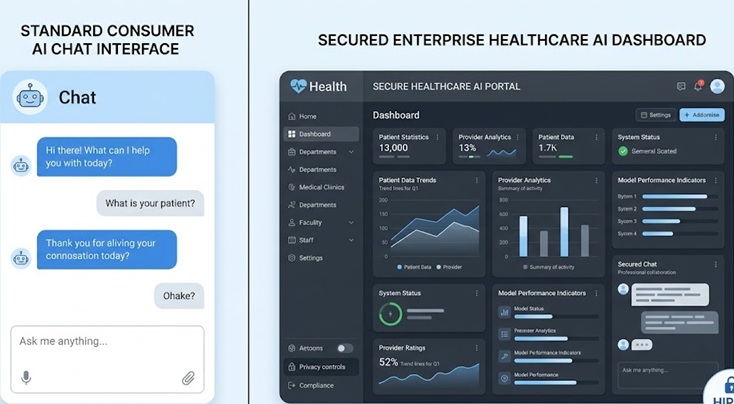
The important nuance is that general consumer Microsoft Copilot accessed through a personal account is not covered. HIPAA compliance applies to enterprise-tier deployments under signed agreements, not to individual staff members using free or personal versions of the same products.
Google Cloud Healthcare AI
Google offers BAAs for Google Cloud services used in healthcare contexts, which includes their Vertex AI platform and the healthcare-specific AI APIs built around their cloud infrastructure. Google's Med-PaLM 2, their large language model fine-tuned on medical knowledge, is available within compliant cloud environments.
Like Microsoft, Google's consumer-facing AI products including the standard Gemini interface accessed through personal Google accounts do not carry BAA coverage. The compliance boundary sits firmly at the enterprise cloud product tier.
AWS HealthLake and Bedrock
Amazon Web Services provides BAA coverage for its healthcare-specific services, including HealthLake for structured health data and Amazon Bedrock, which gives enterprise customers access to foundation models including Claude from Anthropic within AWS infrastructure. Organizations deploying AI through AWS with an active BAA can build HIPAA-capable AI workflows on Bedrock without the compliance exposure that comes with direct API access to the same models.
On-Premise and Self-Hosted Options
For organizations that prefer not to send PHI to any cloud environment regardless of BAA coverage, self-hosted open source models running on private infrastructure represent the most privacy-conservative approach to HIPAA compliant AI tools. When the model runs on hardware your organization owns and controls, PHI never leaves your network perimeter.
This approach requires no BAA because there is no third-party vendor receiving the data. The compliance obligation shifts entirely to your internal security controls and policies. The trade-off is operational responsibility, but for organizations with the technical capacity to run it, the compliance clarity is unmatched.
Reviewing how AI security requirements map to self-hosted deployment options helps organizations assess whether the on-premise route is operationally realistic for their team size and technical infrastructure.
How AI Is Being Used in Healthcare Compliance Today
The relationship between AI and HIPAA runs in both directions, which is worth acknowledging. While AI creates compliance obligations when handling PHI, it is also becoming one of the most effective tools for managing healthcare compliance itself.
Clinical documentation AI helps providers generate accurate, complete notes faster, which reduces the coding errors and documentation gaps that often trigger audit findings. Anomaly detection AI monitors access logs for unusual PHI access patterns that might indicate a breach or insider threat, flagging issues that manual log review would almost certainly miss.
De-identification tools powered by AI can process clinical notes and remove or obscure PHI automatically, enabling datasets to be used for secondary research purposes without triggering HIPAA restrictions on each individual use. Contract analysis AI helps compliance teams review Business Associate Agreements and vendor contracts at scale, surfacing risky clauses faster than attorney review alone can manage.
The AI features built into modern healthcare-focused platforms are increasingly designed with these dual roles in mind, serving both as productivity tools for clinical staff and as compliance infrastructure for the organizations deploying them.

What to Verify Before Deploying Any AI Tool on PHI
The Due Diligence Checklist That Protects Your Organization
Healthcare organizations evaluating AI tools for any use case touching patient data should work through a consistent verification process before deployment. The features and accuracy of the tool are secondary considerations. Compliance qualification comes first.
| Verification Step | What to Confirm | Red Flag |
|---|---|---|
| BAA Availability | Vendor will sign a BAA covering this specific product | Vendor says they are "working on" BAA availability |
| Infrastructure Location | PHI processed and stored within US borders or approved jurisdiction | Unclear or offshore processing infrastructure |
| Subprocessor Transparency | Full list of subprocessors handling PHI disclosed | Vendor cannot or will not disclose subprocessors |
| Breach Notification Terms | Vendor commits to notify within HIPAA's 60-day window | Breach notification terms missing or vague |
| Data Retention and Deletion | Clear policy on how long PHI is retained and how it is deleted | PHI retained indefinitely or used for model training |
| Security Certifications | SOC 2 Type II audit, HITRUST, or equivalent | No third-party security audit documentation |
| Training Data Use | Vendor confirms PHI will not be used to train or improve their model | Terms of service allow training data use without opt-out |
The last point deserves particular attention. Several widely used AI tools include terms of service language that permits using submitted content to improve the model. For consumer tools accessed without an enterprise agreement, that language may apply to everything your staff types into the interface. PHI submitted through a non-enterprise account to an AI tool with that kind of terms of service represents both a HIPAA violation and a potential data exposure that is difficult to remediate after the fact.
The Shadow IT Problem in Healthcare AI
One of the most significant sources of unintentional HIPAA exposure in healthcare organizations today is not bad decisions by IT teams. It is good-faith decisions by clinical staff who have found AI tools that genuinely help their work and started using them before anyone asked the compliance question.
A nurse using a general-purpose AI assistant to draft patient discharge summaries. A physician using a transcription AI on their personal phone to capture clinical notes. An administrator using a free AI writing tool to process referral letters. Each of these represents PHI flowing through systems that almost certainly lack BAA coverage.
Understanding the AI architecture of how data moves through AI tools helps compliance teams explain the risk to clinical staff in terms that land practically, not just as abstract policy reminders.
The solution is not to prohibit AI use, which is both impractical and counterproductive. It is to provide compliant alternatives that meet staff needs so that the path of least resistance is also the compliant path.
Things To Know
A few points that tend to get missed in early healthcare AI compliance planning:
De-identified data is not automatically free of HIPAA obligations in AI contexts. HIPAA's Safe Harbor de-identification standard requires removing eighteen specific identifiers. Many clinical AI workflows involve data that has had obvious identifiers removed but does not meet the full Safe Harbor standard. That data still carries PHI status.
BAA coverage does not transfer automatically between products from the same vendor. A BAA signed for Microsoft Azure does not automatically extend to every Microsoft product. Confirm coverage for each specific product and service in scope.
Model fine-tuning on clinical data requires additional compliance planning. If you plan to fine-tune a model on your organization's patient records, that training process itself involves PHI processing and needs the same safeguards as inference.
Patient authorization does not replace HIPAA technical safeguards. Even if patients have consented to AI-assisted care, that consent does not override the requirement for your AI vendor to have a BAA and appropriate security controls in place.
State law may add requirements beyond federal HIPAA minimums. California, New York, and several other states have health data privacy laws that are stricter than HIPAA in specific areas. A tool that satisfies federal requirements may not satisfy state law obligations for your patient population.
The minimum necessary standard applies to AI prompts. When staff members include PHI in prompts to AI tools, they should include only the specific information the AI needs to complete the task. Including full patient records when only a diagnosis code is relevant is a compliance issue regardless of whether the tool itself is HIPAA compliant.
Using HIPAA Compliant AI Tools With Confidence
The healthcare organizations getting the most value from AI are not the ones moving fastest. They are the ones that built a defensible compliance foundation first and then expanded their AI use confidently within it. A signed BAA, verified technical safeguards, documented staff policies, and a clear process for evaluating new tools before deployment create the conditions where AI can genuinely transform clinical and administrative workflows without creating the regulatory exposure that undermines the benefits.
HIPAA compliant AI tools exist across a range of capabilities and price points. The barrier to compliant AI adoption in healthcare is not technology availability. It is the organizational discipline to ask the compliance question before the deployment question, every time.
Frequently Asked Questions
Does ChatGPT break HIPAA?
Using the standard consumer version of ChatGPT with patient data breaks HIPAA because OpenAI does not sign Business Associate Agreements for its consumer products, meaning PHI submitted through the standard interface is shared with an unauthorized third party. ChatGPT Enterprise and the Azure OpenAI Service offer paths to BAA coverage for qualified healthcare organizations.
What is the 30% rule for AI?
The 30% rule for AI describes the principle that AI should handle roughly 30% of a workflow while humans retain responsibility for the remaining 70% requiring clinical judgment, ethical reasoning, and accountability. In healthcare specifically, this framing helps organizations identify automation opportunities without crossing into clinical decision-making territory where human oversight is both legally required and medically essential.
Is GPT-5 HIPAA compliant?
GPT-5 itself is not inherently HIPAA compliant or non-compliant since compliance depends on the deployment context, the existence of a signed BAA, and the technical safeguards in place, not the model version. Access to GPT-5 through an enterprise agreement that includes BAA coverage and compliant infrastructure would meet HIPAA requirements, while accessing the same model through a consumer account would not.
Is Claude AI HIPAA compliant?
Claude can be used in a HIPAA compliant manner when accessed through AWS Bedrock under an active AWS BAA, which extends compliance coverage to Anthropic's models running within that infrastructure. Accessing Claude directly through Anthropic's consumer API or Claude.ai without enterprise BAA coverage does not satisfy HIPAA requirements for PHI processing.
Is there a free HIPAA compliant AI?
Genuinely free HIPAA compliant AI tools are rare because BAA coverage requires enterprise-tier agreements that vendors do not typically extend to free accounts. The closest practical option is a self-hosted open source model running on your own infrastructure, which eliminates the third-party vendor relationship entirely and therefore removes the BAA requirement, though it replaces it with full internal responsibility for security and compliance.