
AI data privacy risks are more immediate and more personal than most people realise, covering everything from the prompts you type to the files you upload, all of which can be stored, analysed, and in some cases used to train the very model you are talking to. If you have been using AI tools regularly without thinking much about what happens to the information you share, this guide is worth reading before your next session.
The conversation around AI and privacy tends to swing between two extremes. Either people dismiss the concern entirely because nothing bad has happened yet, or they spiral into a level of alarm that makes the technology sound unusable. Neither reaction is helpful. What actually serves you is a clear, grounded understanding of where the real risks live, what you can do to reduce them, and which habits to build before something goes wrong rather than after. That is exactly what this guide delivers.
Where AI Data Privacy Risks Actually Come From
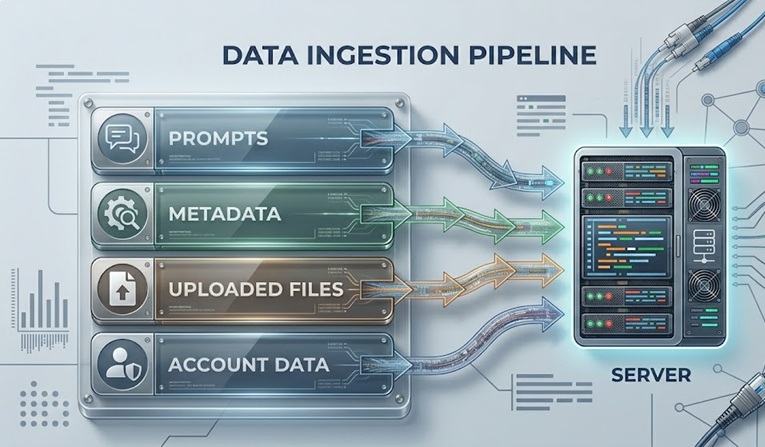
To understand the risk, you need to understand the pipeline. When you type something into an AI tool, that input travels from your device to a remote server where the model runs. It gets processed, a response gets generated, and depending on the platform and your settings, that conversation may be logged, stored, reviewed by human trainers, and used to improve future model versions.
That chain sounds straightforward but each step in it represents a potential exposure point. The data leaves your device. It sits on someone else's servers. It may be retained for months or longer. It may be seen by people outside the AI model itself. And if the company operating the platform experiences a breach, your data is part of what gets exposed.
This is not a hypothetical concern. In 2023, OpenAI confirmed a bug that temporarily allowed some users to see titles from other users' chat histories. Samsung employees made headlines after internal source code and meeting notes were pasted into ChatGPT and subsequently stored on OpenAI's servers. These incidents did not make the technology unusable, but they made clear that AI data privacy risks are not theoretical edge cases. They are events that happen to real organisations when guardrails are not in place.
The risk picture breaks down into three main categories. What gets collected, how it gets used, and who can access it. Understanding all three is what separates informed users from exposed ones.
What AI Tools Collect and Why It Matters
Most people think of their AI interactions as conversations that disappear after the session ends. In reality, the data lifecycle for most consumer AI tools is significantly longer and more complex than that.
Prompt data. Everything you type into an AI tool is collected at minimum for the purpose of generating your response. Beyond that, depending on platform settings, it may be retained for safety review, quality improvement, and model training. The default on most consumer platforms is retention and potential use for training unless you actively opt out.
Usage metadata. Beyond the content of your prompts, platforms typically collect information about how you use the tool, session timing, frequency, device type, location data, and feature usage patterns. This metadata builds a behavioural profile even when the content itself seems innocuous.
Uploaded files and documents. Many AI tools now accept file uploads, images, spreadsheets, and PDFs. Content from these uploads enters the same data pipeline as typed prompts and carries the same retention and usage considerations, often with users assuming incorrectly that uploaded files are handled differently.
Account and identity data. Your email address, payment information, organisation details, and any profile data you provide sits in the same system as your conversation data and is subject to the same breach risk as any other online account.
The reason this matters is not that AI companies are acting in bad faith. Most are not. The reason it matters is that data retained is data at risk, and the more sensitive the information you share, the more significant the consequence if that risk materialises.
Things You Should Never Share With an AI Tool
This is the section most people need most and read least carefully. Being specific about what to keep out of AI tools is more useful than general warnings about being careful.
Passwords and authentication credentials. This should be obvious but it comes up more than you would expect, particularly when people ask AI tools to help debug login systems or troubleshoot account access. Never include real credentials in any prompt regardless of how secure the platform claims to be.
National insurance numbers, tax IDs, and government identifiers. These are the building blocks of identity theft and belong nowhere near a third-party AI system.
Client and customer personal data. Names, email addresses, phone numbers, financial details, health information, and any other personally identifiable information belonging to people other than yourself carries legal and ethical obligations around how it can be shared. Pasting a customer list into a chat window almost certainly violates those obligations.
Proprietary business information. Internal pricing strategy, unreleased product details, merger and acquisition discussions, legal strategy, and competitive intelligence are the kinds of information that companies spend significant resources to protect. Sending them through a consumer AI tool bypasses that protection instantly.
Medical and health information. Your own health data or anyone else's belongs in the same protected category as client data. The sensitivity is high and the regulatory frameworks around health information in many jurisdictions are strict.
Financial account details. Bank account numbers, card details, investment positions, and similar information should stay entirely out of AI workflows regardless of the task.
The security architecture of your AI tools matters here because even with the best personal habits, the platform you are using has to hold up its end of the protection equation for your data to stay genuinely safe.

How Safe Is Your Data With AI, Really?
Giving an honest answer to this question means acknowledging that it varies significantly depending on the platform, the plan tier, and your own practices. It is not a simple yes or no.
| Platform Type | Data Used for Training | Encryption | Human Review Possible | Breach Risk |
|---|---|---|---|---|
| Free consumer AI | Yes by default | Basic | Yes | Present |
| Paid consumer AI | Often opt-out available | Standard | Reduced | Present |
| Enterprise AI plans | No, typically contractual | Advanced | No, typically contractual | Lower but not zero |
| Self-hosted AI models | No, stays on your servers | Your responsibility | No | Lowest |
The enterprise and self-hosted tiers represent meaningfully better data protection than consumer products, but they come with higher cost and greater setup complexity. For most individuals using AI for personal productivity, the consumer product with training data opt-out enabled and careful habits around sensitive inputs is a reasonable baseline. For businesses, the enterprise tier is the responsible starting point.
Understanding the security features of any AI platform before committing to it for regular use is the kind of due diligence that protects you before a problem arises rather than after.
One honest note worth making: no digital system is completely immune to breach. The question is not whether a platform is perfectly secure but whether it takes data protection seriously enough that the risk is proportionate to the value you get from using it.
AI Data Privacy Risks for Businesses Specifically
The stakes around AI data privacy risks are higher for organisations than for individuals because the data involved often belongs to other people, clients, employees, and partners who did not consent to having their information processed through a third-party AI system.
Three categories of business risk stand out above the rest.
Regulatory exposure. Depending on your industry and the regions you operate in, sharing certain types of data with AI tools without proper data processing agreements may put you in violation of GDPR, HIPAA, CCPA, or other applicable regulations. Ignorance of the regulation is not a defence and the penalties in some jurisdictions are substantial.
Client and contractual obligations. Many professional service firms, law offices, financial advisers, and consultancies operate under confidentiality agreements that prohibit sharing client information with third parties. An AI platform almost certainly qualifies as a third party under those agreements, and most employees using AI tools casually are not checking their client contracts before they do it.
Reputational risk. Beyond legal exposure, there is the straightforward reputational damage that comes from a client discovering their data was processed through an AI tool they did not agree to. That conversation is much harder to have after the fact than the policy conversation that prevents it from happening in the first place.
Building responsible AI usage into your business workflow and features from the start is significantly less expensive than managing the consequences of a privacy incident that could have been avoided with a clear policy and the right platform choice.

Why, How, and Which: Building Better Habits Around AI and Privacy
Why do AI data privacy risks deserve more attention than they typically get? Because the adoption curve of AI tools inside organisations has moved far faster than the governance and policy frameworks designed to manage them. Most teams are using AI tools daily that their legal and security departments have never formally evaluated.
How do you build a practical approach without becoming paralysed? Start with a simple personal rule: if you would not be comfortable with that information being visible to a stranger at the AI company, do not put it in the prompt. That rule eliminates most of the high-risk inputs without requiring you to understand the full technical architecture of every platform you use.
For organisations, a three-level framework works well. Green tier covers tasks using only publicly available or non-sensitive information, full AI tool access permitted. Yellow tier covers internal but non-confidential information, enterprise-grade tools required. Red tier covers regulated, confidential, or client-owned data, AI tools prohibited or subject to special review before use.
Which practices make the biggest difference? Three habits stand out above everything else. First, opt out of training data usage on every platform that offers the option. Second, never paste raw sensitive data into a prompt when you can describe the situation without the actual data. Third, treat AI-generated outputs as drafts that require human verification before any consequential decision gets made based on them.
The guide to responsible AI deployment covers how to implement these practices at an organisational level in a way that actually changes behaviour rather than just sitting in a policy document nobody reads.

The Bottom Line on AI Data Privacy Risks
After walking through what gets collected, what to never share, how platforms compare on data protection, and how organisations can build practical governance around these tools, the full picture of AI data privacy risks is one that is serious but manageable.
The technology is not going away and the productivity value is real. The answer is not to avoid AI tools but to use them with the same intentionality you would bring to any system that touches sensitive information. Know what the platform does with your data. Opt out of training where possible. Keep genuinely sensitive information out of consumer-grade tools. Build organisational policies before incidents make them necessary.
AI data privacy risks are not a reason to step back from tools that can make your work meaningfully better. They are a reason to step forward thoughtfully, with your eyes open and the right guardrails in place.
Frequently Asked Questions
What is the 30% rule for AI?
The 30% rule is an informal guideline suggesting that AI-generated content should make up no more than 30% of any final output, with the remaining 70% coming from human input, review, and judgement.
It is not an official standard but it has gained traction as a practical way to prevent over-reliance on AI while still capturing efficiency gains.
What did Stephen Hawking warn about AI?
Stephen Hawking warned that the development of full artificial intelligence could spell the end of the human race if its goals are not carefully aligned with human values and if its growth is not properly controlled.
He expressed concern specifically about the possibility of AI developing autonomously in ways that outpace humanity's ability to manage or understand what it is doing.
What should you never tell ChatGPT?
You should never share passwords, government identification numbers, client personal data, proprietary business information, medical records, or financial account details with ChatGPT or any consumer AI tool.
The core rule is simple: if the information belongs to someone else or could cause harm if exposed, keep it out of the prompt entirely.
How safe is my data with AI?
Your data safety depends on which platform you use, which plan tier you are on, and what privacy settings you have enabled. Enterprise plans generally offer stronger protections than free consumer accounts.
No platform is completely immune to breach, but the gap between a consumer account with default settings and an enterprise account with proper controls is significant enough to matter for business use.
Can AI leak your info?
Yes, AI platforms can expose user data through security breaches, unintended data retention, human review processes, or in rare cases through outputs that inadvertently surface information from other users' inputs.
The risk is not guaranteed but it is real, and the best protection is a combination of choosing reputable platforms, opting out of training data usage, and keeping genuinely sensitive information out of AI tools altogether.