
AI shadow IT risks refer to the security, compliance, and operational dangers that arise when employees use AI tools outside the knowledge or approval of their organization's IT and security teams, often with good intentions but without the guardrails that keep company data protected. If you think this is not happening in your organization right now, the data suggests otherwise.
Studies consistently show that a significant portion of employees across industries are using AI tools their employers have not sanctioned, not because they are trying to cause problems but because the tools are fast, free, and genuinely helpful. The gap between what the business has approved and what employees are actually using is where AI shadow IT risks live, and that gap is wider at most organizations than leadership realizes. This guide covers what it is, why it happens, the specific dangers it creates, and how to close the gap without killing the productivity gains that made people go looking for those tools in the first place.

What Is Shadow IT and Why Has AI Made It Worse?
Shadow IT is not a new problem. It has existed since employees started using personal Dropbox accounts to share work files because the company file server was too slow, or set up their own Slack workspace because the approved communication tool felt clunky. The pattern is always the same. An employee has a need, finds a tool that meets it better than what IT has provided, and starts using it without going through the approval process.
AI has accelerated this pattern dramatically for two reasons. First, the tools are extraordinarily capable and the productivity gains are immediate and visible. An employee who discovers that an AI writing tool cuts their report drafting time in half is not going to stop using it while waiting for a six-month IT security review. Second, most of these tools are free or low-cost and accessible through a browser with nothing to install, which means they leave no footprint in the systems IT typically monitors for unauthorized software.
The result is that AI shadow IT risks have grown from a manageable nuisance into a genuine organizational exposure in a very short period of time. Research from several enterprise security firms in 2024 found that a majority of knowledge workers had used at least one AI tool that their employer had not formally approved. In many organizations, that number includes people in roles with access to sensitive data, client information, and confidential business strategy.
The problem is not the tools themselves. Most of the AI tools employees gravitate toward are legitimate, well-designed products from reputable companies. The problem is the context in which they are being used, with company data, without oversight, and outside the security and compliance frameworks the organization has built.
The Specific Risks That Make Shadow AI Different
Not all shadow IT carries the same risk profile. An employee using an unapproved project management app creates a different level of exposure than an employee pasting client contracts into an AI summarization tool. AI shadow IT risks occupy the higher end of that spectrum for several reasons that are worth understanding clearly.
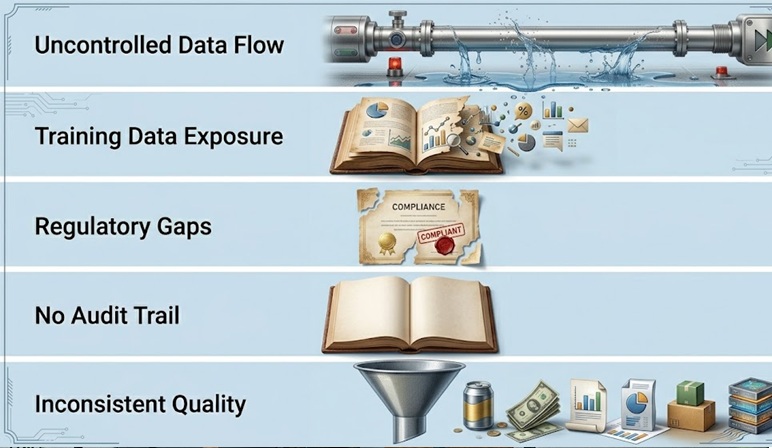
Uncontrolled data flow. When an employee uses an approved enterprise AI tool, the organization typically has a data processing agreement in place, knows what data can be shared, and has some visibility into how that data is handled. When that same employee uses a personal AI account or a free consumer tool for the same task, none of that infrastructure exists. Company data leaves the controlled environment and enters a third-party system under terms the organization never agreed to.
Training data exposure. Consumer AI tools typically use conversation data to improve their models by default. An employee who does not know to opt out of this setting may be contributing proprietary business information, client data, or strategic plans to the training dataset of a public AI model. That information does not disappear when the session ends.
Compliance and regulatory gaps. Organizations in regulated industries operate under strict requirements about how data gets processed and by whom. A financial services firm subject to data residency requirements, a healthcare organization operating under HIPAA, or a legal practice bound by attorney-client privilege rules may be in technical violation of their obligations every time an employee uses an unapproved AI tool with relevant data, regardless of whether any harm results.
No audit trail. When something goes wrong with an approved tool, there is typically logging, incident response capability, and a clear chain of accountability. With shadow AI tools, there is often nothing. The organization cannot determine what data was shared, with what tool, by whom, or when.
Inconsistent output quality feeding decisions. Different AI tools have meaningfully different capabilities, error rates, and hallucination tendencies. When employees are using a patchwork of unapproved tools without a shared standard, the quality of AI-assisted work varies in ways that are invisible to managers and stakeholders who see only the final output.
| Risk Type | What It Means in Practice | Who Feels It Most |
|---|---|---|
| Uncontrolled data flow | Company data in unvetted third-party systems | All organizations |
| Training data exposure | Proprietary info in public AI training sets | IP-sensitive businesses |
| Compliance gaps | Regulatory violations from unapproved data sharing | Healthcare, finance, legal |
| No audit trail | No visibility into what was shared or when | Security and compliance teams |
| Inconsistent output quality | Variable AI work quality across teams | Operations and leadership |
Things To Know About Why Shadow AI Is So Hard to Stop
Before you can address AI shadow IT risks effectively, you need to understand why the standard IT response of blocking and banning tends to backfire in this specific context.
Employees are not the enemy here. The motivations driving shadow AI adoption are almost always legitimate. Faster work, better outputs, competitive pressure, and frustration with slow approval processes are not signs of bad intent. Treating shadow AI as a disciplinary problem rather than an organizational design problem almost always makes it worse by driving usage further underground rather than eliminating it.
The tools change faster than approval processes. A typical enterprise software evaluation takes months. New AI tools are launching and gaining capability every week. Any governance framework that requires full security review before any employee can experiment with an AI tool will be perpetually behind and employees will know it.
Consumer and enterprise versions of the same tool are not equivalent. Many employees using the free consumer version of an AI tool do not realize that their employer could sign up for an enterprise version with completely different data handling terms. The security architecture of enterprise AI platforms is often substantially more protective than the consumer product, but that difference is invisible to an employee who just sees the same interface.
Blocking is less effective than it used to be. Browser-based AI tools with no installation required are much harder to block at the network level than traditional software. And with employees increasingly using personal devices for work tasks, network-level controls do not even apply to a significant portion of actual usage.
The best response combines policy, approved alternatives, and monitoring. Organizations that have made real progress on AI shadow IT risks have done it by reducing the appeal of shadow tools rather than just restricting access to them. Providing approved tools that are actually good enough to meet employee needs, building clear policies that explain what is permitted and why, and implementing monitoring that creates visibility without punishing legitimate productivity are all part of an approach that actually works.

Is Shadow IT Good or Bad? The Honest Answer
The framing of shadow IT as simply bad is understandable from a security perspective but it misses something important about why it keeps happening at every organization that tries to stamp it out.
Shadow IT, including shadow AI, is often a signal. It tells you that the approved tools and processes are not meeting employee needs well enough to compete with what employees can find on their own. Treating it purely as a threat to manage means you address the symptom while leaving the underlying cause untouched.
At the same time, the risks described above are real and in some cases carry serious consequences. The answer is not to celebrate shadow AI or to ignore it, but to understand it as information about where your official tooling and processes are falling short, and use that information to close the gap.
The organizations that handle this best tend to share a few characteristics. They have created a fast-track evaluation process for AI tools that employees actually use, so promising tools can get reviewed and either approved or replaced with a vetted alternative in weeks rather than months. They communicate clearly about what is permitted and why the restrictions that exist are in place, which reduces the tendency to work around rules that feel arbitrary. And they invest in security features and monitoring that give them visibility into AI usage patterns without creating a surveillance culture that damages trust.
The Pros and Cons of Shadow IT: Seeing the Full Picture
Understanding both sides of the shadow IT debate is essential for building a response that is proportionate to the actual risk rather than reflexively restrictive.
Where shadow IT and shadow AI create real value:
Employees on the front line of a workflow often discover genuinely useful tools before IT teams are even aware they exist. Shadow IT has historically been the source of many tools that eventually became official enterprise standards. The grassroots adoption of cloud storage, messaging apps, and now AI tools followed exactly this pattern. The energy behind shadow AI adoption is a signal that employees see real value and want to be more productive. Channeling that energy toward approved pathways is more sustainable than trying to eliminate it.
Where the risks clearly outweigh the benefits:
When sensitive data is involved, the regulatory and contractual obligations that organizations operate under do not have an exception for employee convenience. The consequences of a compliance violation discovered during an audit or a client data exposure traced back to an unapproved AI tool are not proportionate to the productivity gains that motivated the shadow usage. The risk-benefit calculation simply does not work in favor of unmanaged shadow AI when regulated data is in the picture.
| Aspect | Pros | Cons |
|---|---|---|
| Productivity | Real gains from better tools | Quality inconsistency across teams |
| Innovation | Employees surface useful new tools | No standardization or governance |
| Employee experience | Removes friction from daily work | Creates compliance exposure |
| IT and security | Reveals gaps in approved tooling | Creates unmonitored attack surface |
| Compliance | None for regulated data contexts | Potential regulatory violations |

Why, How, and Which: Building a Response That Actually Works
Why does getting this right matter more now than it did even a year ago? Because the capability gap between approved enterprise tools and cutting-edge consumer AI tools has been growing, which means the incentive for shadow adoption has never been stronger. At the same time, AI agents that can take actions on behalf of users, not just generate text, make the potential consequences of unmanaged shadow usage more serious than ever before. An employee using an unapproved AI writing tool is one risk level. An employee using an unapproved AI agent with access to company systems is a fundamentally different one.
How do you build a governance framework that closes the gap without creating resistance? Start with visibility before policy. Deploy monitoring tools that give you a picture of what AI tools are actually being used across your organization before you set rules about what is permitted. You cannot write a policy against risks you do not know exist, and you cannot have a credible conversation with employees about approved alternatives if you do not know what they are currently using instead.
Then build a tiered approval process. Not every AI tool needs the same level of scrutiny. A tool used for internal brainstorming with no sensitive data input carries different risk than a tool used to process client documents. A fast-track category for low-risk tools reduces the frustration that drives shadow adoption while preserving appropriate scrutiny for high-risk use cases.
Which specific controls make the biggest practical difference? Clear acceptable use policies that employees actually understand, approved alternatives that are competitive with what they would find on their own, training that explains the risks in concrete terms rather than abstract security language, and monitoring that surfaces patterns without punishing individuals for experimentation. The practical guide to AI deployment covers how to implement these components in sequence without overwhelming your team or creating policy overhead that slows the organization down.
Reviewing the features of enterprise AI platforms with shadow IT risk reduction as an evaluation criterion, specifically looking at admin controls, usage visibility, and data handling commitments, helps you identify tools that close the gap between what employees want and what IT can safely approve.
Closing Thoughts on AI Shadow IT Risks
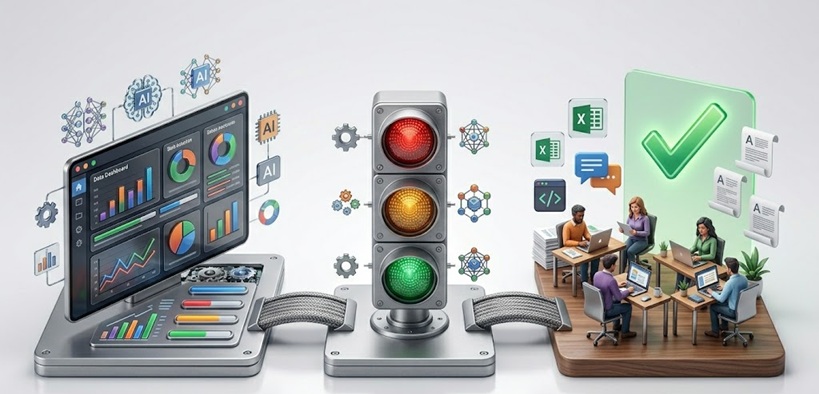
After walking through what drives shadow AI adoption, the specific risks it creates, the honest pros and cons, and the practical response framework, the clearest takeaway is that AI shadow IT risks are fundamentally a governance problem with a productivity dimension, not a security problem with a straightforward technical fix.
The organizations that manage it well are the ones that treat employee behavior as information rather than insubordination, build approved pathways that are actually competitive with shadow alternatives, and invest in visibility before they invest in restrictions. The ones that struggle are the ones that respond with blanket bans, watch those bans get worked around, and never address the underlying gap that made shadow adoption appealing in the first place.
AI tools are not going back in the box. The productivity value is real and employees know it. The question every organization needs to answer is not whether their people will use AI but whether they will use it in ways the organization can see, manage, and stand behind when accountability matters.
Frequently Asked Questions
What are the risks of shadow AI?
The main risks of shadow AI include uncontrolled data flow to unvetted third-party systems, potential exposure of proprietary information through AI training data collection, regulatory compliance violations, lack of audit trails, and inconsistent output quality across teams.
The severity of each risk depends on the sensitivity of the data being processed and the regulatory environment the organization operates in.
What are the risks of using shadow IT?
Shadow IT in general creates risks around data security, compliance violations, lack of IT visibility and control, incompatibility with existing systems, and the absence of support or accountability when something goes wrong.
AI tools amplify these risks because they actively process and potentially retain the content employees share with them, rather than just storing or transmitting it.
Which risks are specific to shadow AI compared to other shadow IT?
Risks specific to shadow AI include the potential for company data to be incorporated into public AI training datasets, the difficulty of auditing what information was shared through natural language inputs, and the risk of AI-generated outputs being used in decisions without any record of how they were produced.
These risks do not apply to most traditional shadow IT tools like unapproved file sharing or communication apps, which store and transmit data but do not process it through a model that may retain and learn from it.
Is shadow IT good or bad?
Shadow IT is neither universally good nor bad. It is a signal that approved tools are not meeting employee needs well enough, which has real value as organizational information, but it also creates genuine security and compliance exposure that cannot simply be ignored.
The most productive response is to use shadow IT patterns as input for improving official tooling and processes rather than treating it purely as a threat to suppress.
What are the pros and cons of shadow IT?
The pros include faster employee access to genuinely useful tools, grassroots innovation that sometimes surfaces tools that become official standards, and reduced friction in daily work. The cons include unmonitored security exposure, compliance risk when sensitive data is involved, lack of organizational visibility, and inconsistency in how work gets done across teams.
The balance tips clearly toward risk when regulated data, client information, or proprietary business content is part of the workflow where shadow tools are being used.