
What is an AI data breach? It is a security incident where an AI system -- through its training data, model outputs, or infrastructure -- leaks, exposes, or mishandles sensitive information without authorisation. As AI tools become part of everyday workflows, understanding this threat is no longer optional for businesses and individuals who care about their digital safety.
You might be asking why any of this matters to you personally. Whether you use a chatbot for customer support, rely on AI-powered tools at work, or simply interact with recommendation engines online, you are already inside the AI ecosystem. When that ecosystem cracks, real data about real people spills out. This guide walks you through exactly what happens, why it happens, and what you can do about it.

What Exactly Is an AI Data Breach?
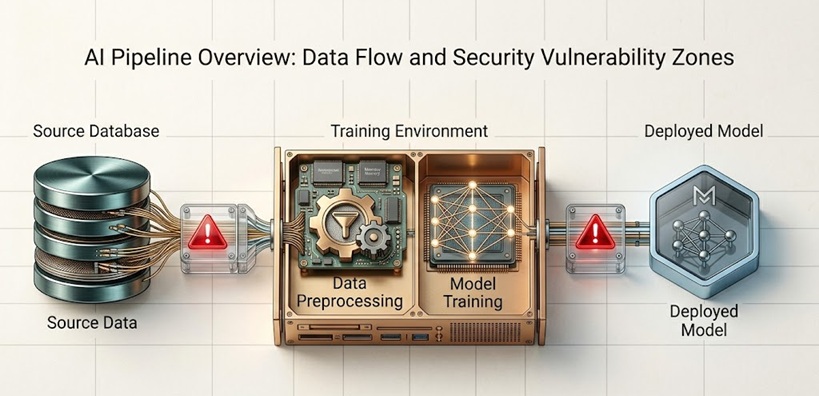
To understand what is an AI data breach, you first need to think about how AI systems actually work. These systems are trained on massive datasets, often containing emails, medical records, purchase histories, or user behaviour logs. That data does not just disappear after training -- it gets embedded into the model in ways that can sometimes be retrieved.
A breach can happen at several layers. The training data itself might be stolen before or during the learning process. The model might "memorise" sensitive entries and reproduce them when prompted the right way. Or attackers might exploit weaknesses in the API or cloud environment where the AI runs.
Here is a useful way to frame it: traditional data breaches are like someone breaking into a filing cabinet. An AI data breach is more like someone finding a way to make the filing cabinet talk -- and it starts listing off everything it ever stored.
Why AI Makes Data Breaches More Complicated
Traditional cybersecurity focused on protecting databases and servers with firewalls and access controls. AI adds several new wrinkles that make defence harder.
For one, AI models can inadvertently memorise specific data points. Research from Google Brain and other institutions has demonstrated that large language models can reproduce exact training data when prompted with partial inputs. This is called a "memorisation attack" and it requires no hacking in the traditional sense -- just clever prompting.
Second, AI pipelines often involve third-party data vendors, cloud inference providers, and open-source model weights. Each handoff point is a potential exposure. Understanding the security architecture behind any AI deployment helps identify where those handoffs create risk.
Third, when a breach does happen, it is harder to define the scope. With a database breach, you can often count the records exposed. With an AI model, you may not know what it memorised, or when it might surface that information again.
Things To Know About AI Data Breaches
Before diving deeper, here are some important facts worth keeping in mind:
- AI systems can expose data without being "hacked" in the traditional sense. Sometimes, the model itself becomes the unintended data source.
- Not all AI data breaches involve malicious actors. Misconfigured storage buckets, overly permissive APIs, or accidental data logging can all cause exposure.
- Regulatory frameworks like GDPR and HIPAA apply to AI-handled data just as they do to any other system. Ignorance of what your AI vendor does with training data is not a legal defence.
- The scale of exposure in an AI breach can be difficult to measure. Unlike a SQL database where rows are countable, a model's "knowledge" of personal data is probabilistic.
- Prompt injection -- where an attacker manipulates input to extract stored information -- is one of the fastest-growing AI attack vectors as of 2024 and 2025.
How an AI Data Breach Actually Happens
There are several distinct pathways for a breach to occur. Understanding each one helps you ask the right questions when evaluating any AI-powered tool.
Training Data Poisoning and Extraction
Attackers who gain access to the data pipeline before training can either steal the dataset outright or insert malicious records. Post-training, a separate class of attacks attempts to extract what the model learnt. Researchers have shown that feeding a model its own output repeatedly -- sometimes called a "data extraction loop" -- can cause it to regenerate verbatim training examples.
API and Inference Layer Attacks
When a model is deployed via an API, every query is an opportunity for probing. An attacker might send thousands of carefully crafted prompts designed to extract personal information the model encountered during training. This is why well-designed security features for AI deployments include query rate limiting, output filtering, and anomaly detection on inference logs.
Third-Party Integration Risks
Many businesses plug AI tools into existing software stacks -- CRMs, HR platforms, healthcare records systems. Each integration creates a new data pathway. If the AI vendor experiences a breach on their end, every connected system's data becomes potentially exposed.
| Attack Vector | How It Works | Who Is Most at Risk |
|---|---|---|
| Training Data Extraction | Prompts designed to reproduce memorised data | Enterprises using custom-trained models |
| API Probing | Repeated queries to map the model's knowledge | Businesses with public-facing AI APIs |
| Third-Party Integration Breach | Vendor's infrastructure is compromised | SMBs using plug-and-play AI tools |
| Misconfigured Storage | Cloud buckets holding training data left open | Organisations with rapid AI deployments |
Real-World Impact: What Gets Exposed?
The types of data at risk in an AI breach vary significantly depending on what the model was trained on or what data it processes at runtime.
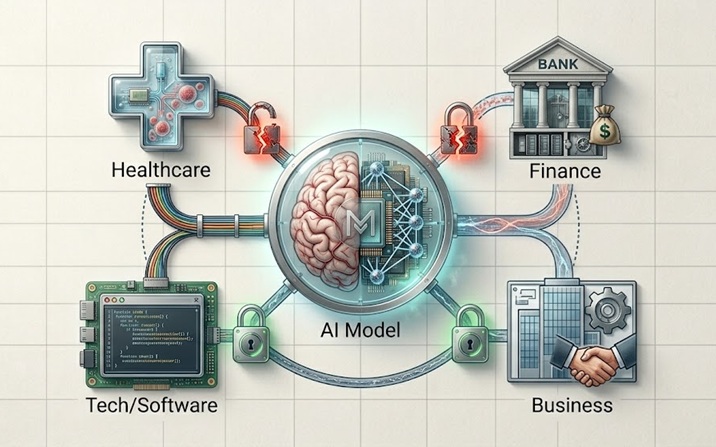
For healthcare AI systems, patient diagnoses, medication histories, and personal identifiers are the obvious concern. For financial AI, transaction patterns, account numbers, and credit behaviour become targets. For enterprise productivity tools -- the kind that summarise emails or generate reports -- an AI breach could expose internal strategy documents, personnel files, or client communications.
In 2023, a widely reported incident involving a popular AI coding assistant revealed that certain prompts could cause the system to reproduce code snippets from private repositories it had been trained on. The developers whose private code appeared did not consent to it being used as training material and had no idea it was even at risk.
That is the uncomfortable reality: you may already have data inside AI systems you never knowingly interacted with.
Comparing AI Data Breaches to Traditional Breaches
It helps to see these two threat categories side by side. While they share some common ground, the differences in detection, scope, and remediation are significant enough to treat them as distinct challenges.
| Factor | Traditional Data Breach | AI Data Breach |
|---|---|---|
| Primary Attack Target | Databases, servers, file systems | Model weights, training data, inference APIs |
| Detection Speed | Hours to days (with proper monitoring) | Often weeks or months, sometimes never |
| Scope Measurement | Countable records | Probabilistic, hard to quantify |
| Remediation | Patch, rotate credentials, notify users | Retrain model, audit data pipelines, restrict prompts |
| Regulatory Clarity | Well-established frameworks | Still evolving in most jurisdictions |
How to Protect Against an AI Data Breach
Knowing the risk is only useful if it leads to action. Here are practical steps that apply whether you are an individual user, a small business owner, or an IT decision-maker.
For Individual Users
Be selective about what you share with AI tools, especially consumer-facing chatbots. If a platform asks you to connect your email, calendar, or documents to improve its AI responses, consider whether that access is truly necessary. Read the privacy policy to understand whether your inputs are used for future training.
For Businesses Deploying AI
Start with a thorough review of your AI vendor's data handling practices. Questions worth asking include: Does the vendor retain user inputs? Are inputs used to retrain shared models? What encryption is applied to data in transit and at rest? How are breaches disclosed to customers?
Building a resilient AI environment also means understanding your own deployment's security posture before something goes wrong rather than after. Proactive audits of who has access to your model's training data, inference logs, and integration credentials are not optional extras -- they are baseline hygiene.
For Technical Teams
Implement output filtering to prevent the model from reproducing patterns that look like personally identifiable information. Set strict rate limits on inference APIs to make large-scale extraction attacks impractical. Log and monitor prompt inputs for anomalous behaviour. And treat model weights like you would treat any sensitive codebase -- with access controls, versioning, and audit trails.
What Happens After an AI Data Breach?
The aftermath of a breach follows a familiar but painful pattern. Organisations scramble to assess scope, notify affected parties, and demonstrate compliance with applicable regulations. In the case of AI breaches, that scope assessment is genuinely harder.
Affected individuals may need to monitor for identity theft or unauthorised account access. Businesses face potential regulatory fines, reputational damage, and the cost of incident response. The remediation process often involves retraining or rolling back the affected model, which can take significant time and resources.
Transparency matters here. Users who are told clearly what happened, what data was involved, and what steps are being taken are far more likely to maintain trust than those who receive a vague notification weeks after the fact.
Final Thoughts on What Is an AI Data Breach
Understanding what is an AI data breach is the first step towards taking the threat seriously. AI systems are not magically more secure than the databases and servers that came before them -- in some ways, they introduce entirely new categories of risk that the security industry is still catching up with.
The good news is that awareness is genuinely protective. Asking the right questions about data retention, model training practices, and API security is something any user or organisation can do today. The more of us who demand clear answers from AI vendors, the stronger the overall ecosystem becomes.
If you are building with AI or simply using it daily, treat data hygiene as a habit, not an afterthought. Your information -- and the information of everyone who trusts you with their data -- depends on it.
Frequently Asked Questions
What is an example of an AI data breach?
A well-known example occurred with an AI coding assistant that reproduced private code from developer repositories during prompting sessions, exposing proprietary code that was never intended to be public.
In practice, this type of breach happens when a model is trained on data it should not have retained, and a cleverly crafted prompt surfaces that information. It does not require a hacker in the traditional sense -- just the right question asked to the wrong model.
What happens after a data breach?
After a breach, organisations assess the scope, notify affected users, report to regulators, and begin remediation -- which may include retraining models, rotating credentials, or patching vulnerable systems.
Affected individuals are typically advised to monitor their accounts and change passwords where relevant.
What are the 4 types of AI risk?
The four commonly cited types of AI risk are security risk, privacy risk, ethical risk, and operational risk.
Security risk covers breaches and adversarial attacks. Privacy risk involves misuse of personal data. Ethical risk refers to biased or harmful outputs. Operational risk includes model failures that affect business continuity.
What does a data breach mean?
A data breach means that unauthorised parties have accessed, exposed, or stolen information that was supposed to be private or protected.
This can involve customer records, internal documents, health data, or any other sensitive information depending on the system affected.
What is an example of a data breach?
One of the most cited examples is the 2013 Yahoo breach, where over three billion user accounts had their email addresses, passwords, and personal details exposed.
In the AI context, a comparable event would be a model trained on private data reproducing that data in response to public queries -- exposing information at scale without a traditional "break-in."