
What can AI agents do? They can autonomously plan, research, execute multi-step tasks, interact with external tools, manage workflows, and self-correct along the way, all without requiring a human to guide every single action. If you have been hearing about AI agents and wondering whether the capabilities are as broad as the hype suggests, the honest answer is yes, and in some areas they go even further than most people realise.
The gap between knowing agents exist and knowing what they can actually accomplish in practice is where most people get stuck. This guide closes that gap. It walks through the real capabilities, the four foundational pillars that make those capabilities possible, the five parts that hold it all together, and the kinds of tasks where agents genuinely outperform every other approach available right now. No filler, just the stuff that actually helps you decide whether and how to use them.

Starting With the Real Question: What Can AI Agents Do That Other Tools Cannot?
The most important thing to understand about agents is not any single capability but the combination. Other software tools are good at one thing. A scheduling app schedules. A search tool searches. A writing tool writes. Agents connect all of those capabilities into a single system that can move between them as a task demands.
That flexibility is what makes the question of what can AI agents do so interesting to answer. The ceiling is not set by one function. It is set by what tools the agent has access to, how clearly the goal is defined, and how well the underlying system is designed to handle real-world complexity.
Here is a representative range of what they handle across different domains:
Research and intelligence gathering. An agent can be given a topic or a set of questions, sent out to search the web, read relevant pages, extract key data points, compare findings across sources, and return a structured summary. Tasks that would take a person several hours can come back in minutes.
Code writing, testing, and debugging. Agents connected to a development environment can read a codebase, identify errors, write fixes, run tests, and flag issues for human review. They do not just suggest what to change, they make the change and verify whether it worked.
Customer communication and support. When connected to a ticketing system and a knowledge base, agents can read incoming support requests, identify the right answer, draft a response, and escalate anything outside their scope. Volume that would overwhelm a small team becomes manageable.
Data processing and reporting. Agents can pull data from multiple sources, clean it, run calculations, generate visualisations, and compile everything into a formatted report on a set schedule. No human has to touch the pipeline unless something breaks.
Workflow coordination. One of the less obvious but highly valuable capabilities is the ability to manage handoffs between systems. An agent can monitor a trigger, kick off the next step, pass the right information to the right tool, and keep the workflow moving without anyone acting as the middle layer.
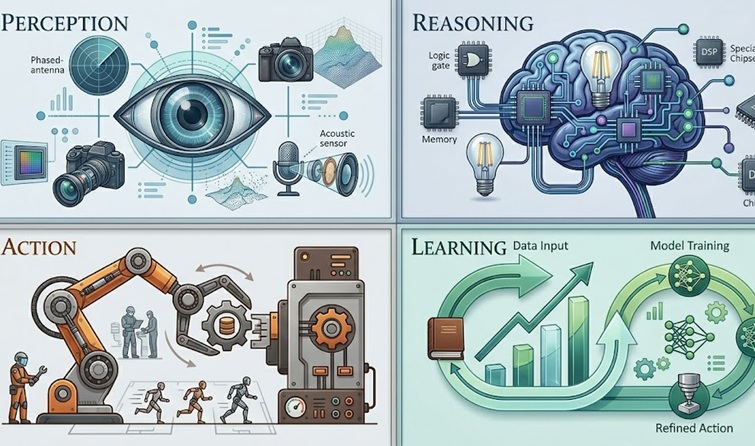
The 4 Pillars of AI Agents
Understanding what can AI agents do becomes clearer when you understand the four foundational pillars that make all of those capabilities possible. These are not just features on a spec sheet. They are the structural elements that separate a capable agent from a fragile one.
1. Perception An agent has to take in information before it can do anything with it. Perception covers how the agent receives input, whether that is a user message, a database query result, a webpage, an API response, or a file. The quality and breadth of what an agent can perceive directly limits what it can act on.
2. Reasoning This is where the language model does its work. The agent processes what it has perceived, applies relevant knowledge, identifies what matters, and decides what to do next. Stronger reasoning means better decisions at every branch point in a complex task.
3. Action Reasoning without action is just analysis. The action pillar is what allows an agent to actually do something in the world, calling tools, writing outputs, sending messages, running code, updating records. This is where the value becomes tangible.
4. Learning and Adaptation The most capable agents do not just complete tasks. They track what worked and what did not, adjusting their approach over time. This feedback loop is what allows agents to improve on repeated workflows rather than making the same mistakes indefinitely.
These four pillars work together. Weaken any one of them and the whole system underperforms. An agent with strong reasoning but limited action capabilities hits a ceiling fast. An agent with broad action capabilities but weak reasoning becomes unpredictable. The system architecture of the platform you build on determines how well all four pillars hold up under real conditions.
The 5 Parts of an AI Agent
Beyond the four pillars, every functional AI agent is built from five specific components. Knowing what each one does helps you evaluate any agent system more accurately and understand why some feel reliable while others feel inconsistent.
| Component | Role in the Agent | What Breaks Without It |
|---|---|---|
| Perception Module | Takes in information from the environment | Agent cannot respond to real-world inputs |
| Memory System | Stores context, history, and learned data | Agent forgets earlier steps and repeats errors |
| Reasoning Engine | Interprets inputs and decides next actions | Agent makes poor decisions or gets stuck |
| Action Module | Executes decisions using tools and APIs | Agent can think but cannot do anything |
| Evaluation Layer | Checks outputs against the goal | Agent cannot self-correct when things go wrong |
The evaluation layer is the one most often underinvested in during early development and the one that causes the most production failures. An agent that cannot check its own work will confidently deliver wrong results without any indication that something went sideways. Building in proper evaluation from the start is one of the most practical pieces of advice for anyone deploying agents for real work.
Things To Know About What AI Agents Can and Cannot Do
Alongside the capabilities, there is an honest set of limitations and considerations worth understanding before you invest time or resources in an agent-based approach.
Agents are not magic. The quality of the output depends directly on the quality of the goal definition, the tools available, and the design of the system. A poorly scoped agent on a well-designed platform will still underperform. A well-scoped agent on a poorly designed platform will too.
Some tasks are genuinely not suited for agents. One-off creative tasks that depend on human taste, decisions that carry significant ethical or legal weight, and situations where the cost of an error is very high are all areas where human judgement should stay in the loop. Agents work best where the task is repeatable, the success criteria are measurable, and errors can be caught before they cause serious problems.
Security is not an afterthought. Agents that have access to internal systems, customer data, or external APIs represent a meaningful attack surface if not properly secured. Reviewing the security capabilities of your agent platform before connecting it to anything sensitive is one of those steps that feels optional until something goes wrong.
The best agent deployments start narrow. Teams that try to automate everything at once with agents rarely get good results. Teams that pick one specific, well-understood workflow, get the agent running reliably on that, and then expand from there almost always do better.
Cost scales with complexity. Every tool call, every reasoning step, and every API interaction adds cost. Agents running long chains of actions on high-frequency tasks can become expensive quickly if not designed with efficiency in mind from the start.
IMAGE SUGGESTION: An illustration of a person reviewing a checklist while a robot assistant stands nearby. The checklist has checkmarks next to some items and an X or pause symbol next to others, suggesting a balanced and thoughtful evaluation of what to automate and what to keep manual. Clean professional style, no text on image.
The 5 Types of Agents in AI
Not every agent that can do these things is built the same way. The five types of agents in AI represent a spectrum from simple rule-followers to systems that genuinely improve over time.
Simple Reflex Agents respond to current inputs using fixed rules. If this condition, then that action. No memory, no planning. Fast and predictable for narrow tasks with consistent conditions.
Model-Based Reflex Agents maintain an internal model of the world so they can handle situations where not everything is directly visible. They use what they know to fill in gaps, making them more adaptable than pure reflex agents.
Goal-Based Agents work backward from a desired outcome. Rather than just reacting, they evaluate actions based on whether those actions move them closer to the goal. This is where genuine planning begins.
Utility-Based Agents go a step further by weighing options based on a utility score. They do not just find a path to the goal, they find the best path, balancing speed, cost, risk, and quality in their decision-making.
Learning Agents improve their own behaviour over time by tracking performance and adjusting. They are the most resource-intensive type to build and maintain but deliver compounding value on tasks that repeat and evolve.
| Agent Type | How It Decides | Best Fit |
|---|---|---|
| Simple Reflex | Fixed rules, current input only | Predictable, repetitive triggers |
| Model-Based Reflex | Internal world model plus rules | Tasks with partial information |
| Goal-Based | Evaluates actions against a goal | Multi-step planning tasks |
| Utility-Based | Scores options on multiple criteria | Optimisation-heavy workflows |
| Learning | Adapts based on past performance | Long-running, evolving processes |
IMAGE SUGGESTION: A vertical ladder or staircase illustration with five steps, each labeled with one agent type from bottom to top, showing increasing capability as you move up. Each step has a small icon representing its decision-making style. Simple, clear, no text on image, consistent design language throughout.
Why, How, and Which: Putting It All Together
Why does understanding what can AI agents do actually matter? Because the teams getting the most value from AI right now are not necessarily using the most advanced models. They are using agents well, meaning they have matched the right capability to the right problem and designed the workflow so the agent can succeed reliably.
How do you find the tasks where agents make the biggest difference? Look for work that happens frequently, follows a pattern, requires touching multiple tools, and currently depends on a human to coordinate the pieces. Any workflow that involves collecting information from one place, processing it, and sending it somewhere else is a strong candidate. Anything that currently lives on someone's recurring to-do list because nobody has automated it yet is worth a close look.
Which approach delivers the best results? Start with a goal-based agent on a single workflow where you already know what success looks like. Use the evaluation layer to measure whether the agent is hitting that standard. Adjust the goal definition and tool setup before changing the underlying model. Most underperforming agents are not failing because of the model, they are failing because of unclear goals or missing tools.
The features available on modern agent platforms cover most of the common tool integrations out of the box, which means getting a basic agent running on a real workflow is less technical work than it was even a year ago. The harder part is identifying the right workflow and defining the goal clearly enough for the agent to succeed.
IMAGE SUGGESTION: A person pointing at a large screen displaying a workflow with a green checkmark at the end. An AI agent figure stands alongside, looking at the same screen. The scene communicates collaboration between human judgment and agent execution. Modern, clean illustration style, no text on image.
What AI Agents Can Do: Putting It in Perspective
After walking through the capabilities, the four pillars, the five parts, and the five types, the answer to what can AI agents do is genuinely broad. Research, code, communicate, coordinate, analyse, adapt, and improve. That list covers a significant portion of what knowledge workers spend their time on every day.
The more useful framing is not what agents can do in theory but what they can do reliably for your specific situation. That answer depends on how clearly you define the goal, how well the tools are connected, and how thoughtfully the workflow is designed. Get those three things right and the range of what becomes possible expands considerably. Start with the practical implementation guide if you are ready to move from understanding to actually building something that works.
Frequently Asked Questions
What can you do with AI agents?
You can use AI agents to automate research, manage workflows, write and test code, handle customer communications, process data, and coordinate multi-step tasks across different tools and systems.
The common thread is that all of these involve multiple steps, external tool access, and a defined goal. Agents handle the execution while humans focus on oversight and judgement.
What are the 5 types of agents in AI?
The five types are simple reflex agents, model-based reflex agents, goal-based agents, utility-based agents, and learning agents.
Each type handles increasing levels of complexity. Simple reflex agents follow fixed rules while learning agents adapt their behaviour based on past performance.
What are the 4 pillars of AI agents?
The four pillars are perception, reasoning, action, and learning and adaptation.
Together they allow an agent to take in information, decide what to do with it, execute that decision through tools, and improve over time based on results.
What are the 5 parts of an AI agent?
The five core parts are the perception module, memory system, reasoning engine, action module, and evaluation layer.
Each part handles a specific function. The evaluation layer is the most commonly underbuilt component and the one most responsible for inconsistent performance in production deployments.
Who are the Big 4 AI agents?
The four most prominent organisations advancing AI agent technology are OpenAI, Google, Anthropic, and Microsoft.
OpenAI leads on model capability and developer tools. Google integrates agents across its search and cloud products. Anthropic focuses on safe and reliable reasoning. Microsoft deploys agents at enterprise scale through Copilot and AutoGen.