
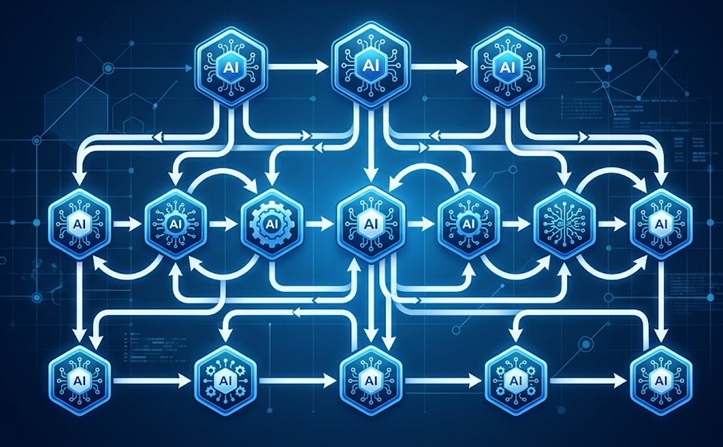
Multi agent AI systems are architectures in which multiple specialised AI models operate collaboratively, each handling a distinct role within a shared workflow, to complete tasks too complex or too broad for any single model to handle reliably on its own. Rather than asking one AI to do everything, these systems divide the work across agents that plan, execute, verify, and coordinate towards a shared objective.
The shift from single-model AI to multi-agent architecture is one of the most significant developments in applied AI for business in recent years, and it is happening faster than most organisations have had time to evaluate it properly. A single AI assistant, however capable, hits practical limits when tasks require sustained reasoning across many steps, parallel processing of different workstreams, or specialised expertise applied simultaneously across distinct domains. Multi agent AI systems address those limits by design, distributing work across agents whose combined output exceeds what any individual model could produce alone. The analogy to human organisations is deliberate and useful. A single generalist employee handles straightforward tasks efficiently. A project requiring legal analysis, financial modelling, technical implementation, and customer communication simultaneously needs a team, each member contributing their specific capability towards the shared goal. Multi-agent AI works on the same principle. This guide explains how these systems are built, where they are delivering real business value, and what organisations deploying them need to manage carefully.
Why Single-Agent AI Has Practical Limits for Complex Business Work
The Problem With Asking One Model to Do Everything
The most capable large language models available today are genuinely impressive general-purpose systems. They can write, reason, code, analyse, summarise, and plan with a level of coherence that would have seemed implausible a few years ago. For well-defined, bounded tasks, a single capable model with good instructions does excellent work.
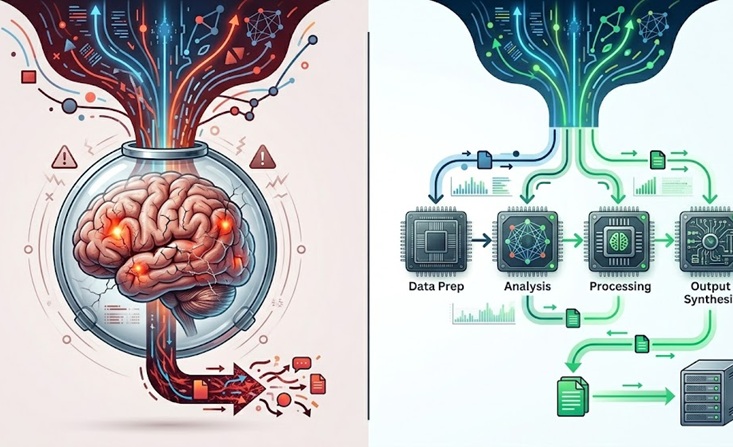
Complex, multi-step business processes expose the limits of that architecture in predictable ways. Context window constraints mean a single model working on a long, complex task loses access to earlier reasoning and decisions as the task progresses. The longer the chain of reasoning required, the more errors accumulate as early mistakes compound through subsequent steps. A single model asked to simultaneously plan a project, research its components, draft its deliverables, review them for quality, and coordinate handoffs between stakeholders is being asked to do things that compete for the same limited processing attention, with predictable quality degradation across the most demanding dimensions.
Multi agent AI systems solve this by decomposing complex tasks into components that match the natural architecture of the work. A planning agent handles project decomposition. Research agents gather and synthesise relevant information. Specialist agents apply domain expertise to specific components. A review agent checks outputs against quality standards. An orchestration layer coordinates the sequence and manages information flow between agents. The result handles complexity that would overwhelm any single model while maintaining quality across every component.
How Context and Specialisation Change What Is Possible
Beyond raw complexity handling, multi-agent architectures enable a level of specialisation that generalist single-model deployments cannot match. An agent that is fine-tuned, prompted, and configured specifically for legal document analysis brings different capability to that task than a general-purpose model handling legal analysis as one of dozens of task types it performs. When multiple specialised agents collaborate, the combined output reflects genuine domain depth across all involved specialisations simultaneously.
This specialisation benefit compounds when agents are equipped with different tools as well as different capabilities. A research agent with web search access, a data analysis agent with code execution capability, a document agent with file system access, and a communication agent with email integration each bring their tools to bear on their specific portion of a workflow. The orchestrating system combines their contributions in ways that no single agent with any single tool set could replicate.
Understanding how AI architecture decisions in multi-agent systems affect both capability and risk helps organisations design deployments that deliver the complexity-handling benefits of the architecture while managing the expanded attack surface and coordination complexity it introduces.
How Multi Agent AI Systems Are Structured
The Core Roles Within a Multi-Agent Architecture
While specific implementations vary considerably, most multi agent AI systems organise their agents around a consistent set of functional roles that reflect the natural structure of complex task execution.
The orchestrator agent is the coordinating intelligence that receives the overall objective, decomposes it into component tasks, assigns those tasks to appropriate specialist agents, manages the sequence of operations, and synthesises final outputs from component results. The orchestrator does not necessarily do the detailed work of any individual component. Its job is coordination, sequencing, and integration.
Specialist agents are configured for specific task types and equipped with the tools and context relevant to those tasks. A research specialist might have web search and document retrieval capabilities. A coding specialist has code execution and testing tools. A data analysis specialist has computational and visualisation tools. The value of each specialist comes from the combination of its domain configuration and its specific tooling, not from general capability alone.
Critic or review agents examine outputs from other agents against defined quality criteria, checking for errors, inconsistencies, hallucinations, or gaps before those outputs move to subsequent stages or reach human review. Building review into the architecture rather than relying on post-hoc human checking reduces error propagation through long task chains.
Memory and state management components maintain shared context that agents need to coordinate effectively, ensuring that decisions made early in a workflow are visible to agents working on later stages rather than requiring each agent to rediscover or re-derive context that has already been established.
| Agent Role | Primary Function | Key Capability |
|---|---|---|
| Orchestrator | Task decomposition, sequencing, integration | Planning, coordination, synthesis |
| Research Specialist | Information gathering and synthesis | Web search, document retrieval, RAG |
| Analysis Specialist | Data processing and interpretation | Code execution, computation, visualisation |
| Domain Specialist | Expert task handling in specific fields | Fine-tuned domain knowledge, specialised tools |
| Critic or Review Agent | Quality checking and error detection | Consistency verification, fact checking, rubric evaluation |
| Memory and State | Context preservation across agent interactions | Shared working memory, decision logging |
Communication Patterns Between Agents
How agents communicate with each other within a multi-agent system determines both its capability and its reliability. Different communication patterns suit different types of complex tasks.
Sequential pipelines pass work from one agent to the next in a defined order, with each agent's output becoming the next agent's input. This pattern works well for tasks with clear stage dependencies where each step builds directly on the previous one. Document drafting workflows, where a research agent feeds a drafting agent that feeds a review agent, often follow this pattern effectively.
Parallel execution runs multiple agents simultaneously on independent subtasks, with an orchestrator collecting and integrating their outputs when all have completed. Market research workflows that need simultaneous analysis of multiple competitors, data sources, or geographic markets benefit from this pattern because the parallelism dramatically reduces the time required compared to sequential processing.
Hierarchical delegation creates multiple layers of orchestration, with a top-level orchestrator delegating to mid-level coordinators that manage their own specialist agents. This pattern handles the most complex, large-scale tasks but introduces coordination overhead that needs to be managed carefully to avoid the communication complexity overwhelming the efficiency gains.
Reviewing how AI features in enterprise multi-agent platforms implement these communication patterns helps organisations select architectures that match the actual structure of their target workflows rather than fitting their processes into whatever pattern a particular platform favours.
Where Multi Agent AI Systems Are Delivering Business Value
Software Development and Engineering Workflows
Software engineering is one of the most mature and well-documented application domains for multi-agent AI. The natural decomposition of software development into planning, coding, testing, review, and documentation maps cleanly onto multi-agent architecture, and the availability of code execution tools that agents can use to verify their outputs makes the domain particularly well-suited to automated quality control.
A software development multi-agent system might involve a planning agent that decomposes feature requirements into implementation tasks, specialist coding agents that implement individual components, a testing agent that writes and executes tests against each component, a review agent that checks code quality and security against defined standards, and a documentation agent that produces technical documentation from the implemented code. The combined output of this system handles tasks that previously required sustained human engineering time across multiple disciplines.
The value is not just speed. It is the consistent application of quality standards across every component without the attention variability that human developers working on repetitive tasks over long sessions inevitably exhibit. Testing coverage, documentation completeness, and code review thoroughness can be maintained at a consistent level across every component the system produces.
Research, Analysis, and Intelligence Workflows
Complex research and analysis tasks that require gathering information from multiple sources, processing it through different analytical lenses, and synthesising coherent conclusions are natural fits for multi-agent architecture. The parallel processing capability allows simultaneous research across multiple dimensions that would be sequential and therefore much slower with a single agent or human researcher.
A competitive intelligence workflow might deploy research agents simultaneously across competitor product documentation, regulatory filings, patent databases, and news coverage, with analysis agents processing each stream for relevant signals, and a synthesis agent integrating findings into a coherent intelligence briefing. The same workflow run sequentially by a single agent or human analyst takes proportionally longer with no quality improvement to justify the additional time.
For organisations managing ongoing intelligence functions, such as regulatory monitoring, competitive surveillance, or market trend analysis, multi-agent systems deployed on scheduled cycles provide consistent coverage at scale that human teams struggle to match on the same resource investment.
Customer Operations and Service Automation
Customer-facing operations represent a significant multi-agent deployment area where the capability to handle complex, multi-step customer interactions with specialised expertise at each stage delivers measurable service quality improvements.
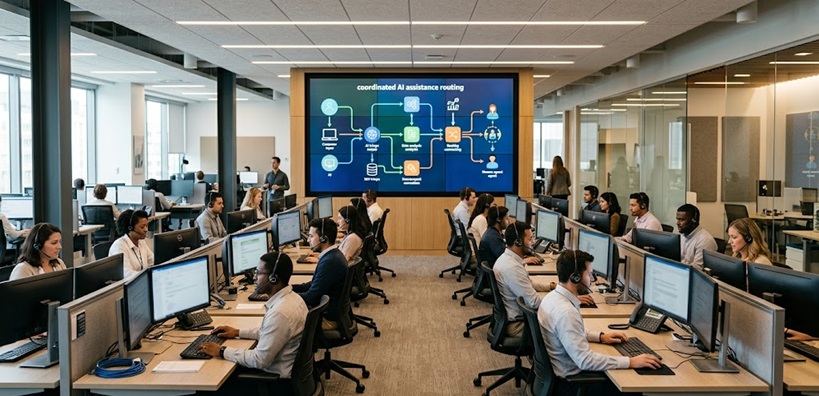
A customer service multi-agent system handling a complex product return and replacement request might involve a context agent that retrieves the customer's full history and policy entitlements, a decision agent that assesses eligibility against current policy, a resolution agent that identifies and proposes appropriate solutions, a communication agent that drafts the customer response in the appropriate tone and format, and a logging agent that records the interaction for compliance and quality monitoring. Each specialised agent contributes its specific capability to an interaction that requires all of them, producing better outcomes than a single general-purpose agent handling all dimensions simultaneously.
The key to making this work in customer-facing contexts is maintaining coherent, consistent communication despite the multi-agent complexity operating behind the interface. From the customer's perspective, they are interacting with a single, well-informed, capable service system. The internal architecture that produces that experience is invisible to them and should remain so.
Understanding how AI security requirements apply to multi-agent systems that access customer data, process sensitive information, and take consequential actions on behalf of users is essential before deploying these architectures in customer-facing contexts where error consequences include real customer impact and potential regulatory exposure.
What Organisations Need to Manage Carefully in Multi-Agent Deployments
Cascading Errors and Quality Control
The same architectural property that makes multi agent AI systems powerful, chaining multiple agents together towards complex outcomes, also creates a failure mode that single-agent systems do not have. An error introduced early in a multi-agent workflow propagates to subsequent agents that build on that flawed foundation, potentially amplifying rather than catching the initial mistake before it reaches a human reviewer or produces an external output.
A research agent that retrieves inaccurate information feeds an analysis agent that builds conclusions on that inaccurate foundation, which feeds a reporting agent that presents those conclusions with analytical authority. Each agent in the chain has done its job correctly given its inputs. The system as a whole has produced a well-structured, confidently presented analysis built on a false premise.
Building explicit quality checkpoints into multi-agent workflows, using critic agents to verify outputs before they progress to subsequent stages, and maintaining human review at consequential decision points are the architectural responses to this failure mode. The goal is catching errors at the stage where correction is least expensive rather than discovering them in final outputs.
Expanded Attack Surface and Security Considerations
Multi-agent systems that are connected to multiple data sources, tools, and external services have a significantly larger attack surface than single-model deployments with limited connectivity. Each tool an agent can use, each data source it can access, and each external system it can interact with is a potential vector for prompt injection, unauthorised data access, or unintended consequential actions.
The principle of least privilege is even more important in multi-agent deployments than in single-agent ones. Each agent should have access only to the tools, data sources, and capabilities it specifically requires for its designated function. An orchestrator that has access to every tool in the system is a much higher-value attack target than one that can only coordinate and route tasks. A research agent that can only read from approved sources is significantly safer than one with unrestricted web access and file system permissions.
The 30% principle applies usefully to multi-agent action authorisation. Agents should execute routine, well-defined actions within their scope autonomously, roughly 30% of the workflow actions, while actions with significant consequences, external visibility, or irreversibility require human authorisation before execution. Building that human checkpoint architecture into multi-agent workflows prevents the scenario where an autonomous system takes consequential actions faster than any human reviewer could evaluate them.
| Risk Area | Multi-Agent Specific Concern | Mitigation Approach |
|---|---|---|
| Cascading Errors | Early mistakes amplify through agent chain | Critic agents, inter-stage quality checks |
| Prompt Injection | Malicious content injected through any agent's data source | Input validation at each agent boundary |
| Scope Creep | Agents accessing beyond their intended boundaries | Strict least-privilege tool and data access |
| Irreversible Actions | Autonomous execution of consequential operations | Human authorisation gates for high-impact actions |
| Audit and Accountability | Complex agent interactions difficult to trace | Comprehensive logging at every agent interaction |
| Coordination Overhead | Communication complexity reducing efficiency gains | Architecture simplification, clear interface contracts |
A thorough AI guide on security architecture for multi-agent deployments helps organisations build systems that harness the productivity potential of agent collaboration without creating the security and governance gaps that unmanaged multi-agent autonomy introduces.
Things To Know
Several important realities about multi agent AI systems that organisations consistently encounter during planning and deployment:
Orchestration complexity scales quickly. Adding agents to a multi-agent system increases coordination complexity non-linearly. A system with three agents has manageable communication patterns. A system with twelve agents has coordination complexity that can overwhelm the efficiency gains from specialisation if the orchestration architecture is not designed carefully from the start.
Latency accumulates across agent steps. Each agent interaction in a sequential workflow adds latency. Multi-agent systems that need to deliver results in real time, such as customer service applications, require careful architecture to parallelise where possible and minimise sequential dependencies that force one stage to wait for another.
Testing multi-agent systems requires different approaches than testing single-model deployments. Individual agent testing and end-to-end system testing both matter, but the interaction between agents, particularly how errors and edge cases propagate through agent chains, requires specific integration testing that neither component-level nor end-to-end testing fully covers.
Cost management becomes complex with multiple agents. Each agent interaction incurs inference cost, and complex multi-agent workflows running many agent steps per user request can generate significantly higher per-interaction costs than single-model deployments. Modelling the cost structure before deployment prevents budget surprises when usage scales.
Human oversight points need to be designed in, not added later. The hardest governance problem in multi-agent systems is identifying which decisions within a complex automated workflow require human review before execution proceeds. Attempting to retrofit human oversight into a multi-agent system after deployment is significantly harder than designing oversight points into the architecture before it is built.
Failure modes in multi-agent systems can be difficult to diagnose without comprehensive logging. When a multi-agent workflow produces a wrong result, identifying which agent introduced the error and why requires complete logs of every agent interaction, the inputs each agent received, and the outputs it produced. Organisations that treat logging as optional discover during their first incident investigation that reconstruction of agent behaviour without logs is often impossible.
Framework choices affect long-term flexibility. The growing ecosystem of multi-agent frameworks including LangGraph, AutoGen, and CrewAI each make different architectural assumptions that affect how easily a system can be modified, extended, or migrated as requirements evolve. Evaluating framework flexibility against long-term roadmap requirements before committing to an implementation approach prevents expensive rearchitecting later.
Building Multi Agent AI Systems That Deliver Durable Value
The organisations extracting the most sustained value from multi agent AI systems share a consistent approach to how they build and govern them. They start with a specific, well-understood complex workflow rather than building a general-purpose multi-agent platform and hoping valuable use cases emerge. They design quality checkpoints and human oversight into the architecture rather than treating agent autonomy as inherently desirable. And they invest in the logging and observability infrastructure that makes system behaviour understandable and improvable over time.
Multi-agent architecture is genuinely powerful for the class of complex, multi-step, multi-domain tasks that single-model approaches handle poorly. That power comes with real architectural and governance complexity that organisations need to approach deliberately rather than inherit by default. The teams that get this right are not necessarily the most technically sophisticated ones. They are the ones that are clearest about what problem they are solving, most rigorous about where human judgement needs to stay in the loop, and most disciplined about building governance and observability into the foundation rather than as afterthoughts.
The trajectory of multi-agent AI capability is clearly upward. The organisations building strong architectural and governance foundations now are developing the organisational capability to take advantage of that trajectory as it develops, rather than catching up to it from behind.
Frequently Asked Questions
What are multi-agent AI systems?
Multi-agent AI systems are architectures in which multiple specialised AI models work collaboratively within a shared framework, each handling a distinct role such as planning, research, analysis, execution, or quality review, to complete tasks that are too complex, multi-step, or multi-domain for any single model to handle reliably on its own. The agents communicate, share context, and coordinate their outputs under an orchestration layer that manages sequencing and integration, producing combined results that reflect genuine specialisation across every component of the workflow.
What are the 4 types of AI systems?
The four primary types of AI systems are reactive machines that respond to current inputs without memory or learning, limited memory systems that use historical data to inform current decisions, theory of mind systems that model the beliefs and intentions of other agents, and self-aware systems that have genuine consciousness and self-understanding. Most practical business AI systems today, including multi-agent architectures, fall into the limited memory category, using learned patterns and retrieved context to produce useful outputs without the more advanced cognitive properties of the later categories.
What are the 4 types of agents in AI?
The four main types of agents in AI are simple reflex agents that respond directly to current percepts, model-based reflex agents that maintain internal state to handle partial observability, goal-based agents that evaluate actions against desired outcomes, and utility-based agents that optimise decisions based on a preference function over possible outcomes. In multi-agent business systems, most deployed agents are goal-based or utility-based, using defined objectives and quality criteria to guide their behaviour within their designated role in the broader workflow.
What are the top 3 AI agents?
Among the most widely deployed and discussed AI agent frameworks in 2026 are OpenAI's Agents SDK which provides infrastructure for building tool-using agents with handoff capabilities, Anthropic's Claude used extensively as both an orchestrator and specialist agent within multi-agent pipelines, and AutoGen from Microsoft Research which enables flexible multi-agent conversation patterns for complex task automation. The rapidly evolving agent framework landscape means that what constitutes a top agent changes frequently as new capabilities emerge, making architectural flexibility more valuable than commitment to any single framework.
Who are the big 4 AI agents?
The big four organisations shaping enterprise multi-agent AI deployment are OpenAI with its Agents SDK and GPT-based agent capabilities, Anthropic with Claude's strong reasoning and tool-use performance in agentic contexts, Google with its Vertex AI agent builder and Gemini-based agent infrastructure, and Microsoft with its AutoGen research framework and Copilot Studio agent orchestration platform. Each brings different architectural strengths, compliance postures, and ecosystem integrations, making the right choice dependent on your existing technology infrastructure, regulatory requirements, and specific workflow complexity rather than on any single capability comparison.