
How do AI agents work? At their core, AI agents follow a continuous loop of perceiving information, reasoning through it, planning a response, and taking action to complete a goal, all without needing a human to manage every single step. If you have been hearing the term everywhere lately and want to understand what is actually happening under the bonnet, this guide gives you the full picture in plain language.
Most explanations either get too technical too fast or stay so surface-level that you walk away knowing nothing useful. This one sits right in the middle. Whether you are a business owner exploring automation, a developer considering building with agents, or just someone who wants to sound informed at the next tech conversation, keep reading.

The Simple Version First
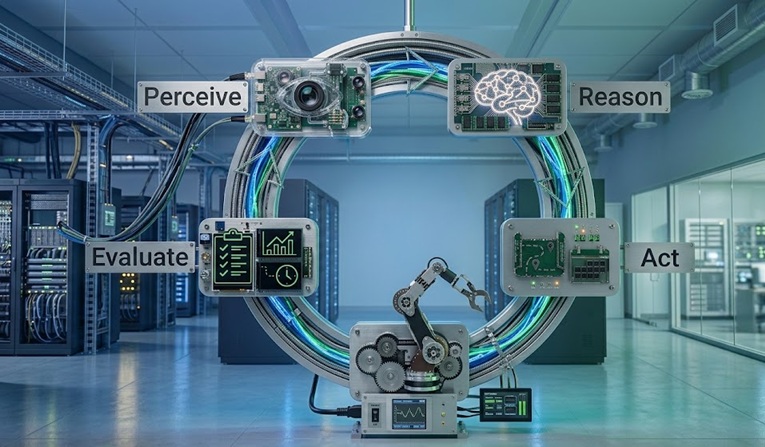
Before going deeper, here is the core idea in one clear picture.
Think about how a new hire handles a task at work. They get a goal, gather information, figure out the steps, do the work, check if it came out right, and adjust if something went wrong. An AI agent does the exact same thing, just digitally, faster, and without needing coffee breaks.
The "intelligence" part comes from a large language model doing the reasoning. The "agent" part comes from connecting that reasoning to real tools, like web browsers, code editors, APIs, calendars, and databases, so it can actually do things in the world rather than just talk about them.
That combination of reasoning plus action is what separates an agent from a standard chatbot.
How Do AI Agents Work, Step by Step?
Understanding how do AI agents work becomes much clearer when you walk through the actual process they follow. It is a loop, not a straight line, and that loop is what makes them so adaptable.
Step 1: Perception The agent takes in information from its environment. This could be a message from a user, data pulled from a file, a search result, an API response, or even sensor data in more advanced setups. Think of this as the agent opening its eyes and ears.
Step 2: Reasoning The language model at the centre of the agent processes what it just perceived. It figures out what the situation means, what the goal is, and what knowledge applies here. This is the thinking stage.
Step 3: Planning The agent maps out the sequence of actions needed to move toward the goal. Should it search the web first? Write some code? Send an email? Check a database? It decides the order and the tools.
Step 4: Action The agent executes the plan by calling tools, APIs, or other systems. This is where it actually does something in the real world, not just describes what should be done.
Step 5: Evaluation After acting, the agent checks whether the output matched the goal. If it did, great. If not, it loops back, adjusts its reasoning, and tries again. This self-correction loop is what gives agents their problem-solving capability.
The 5 Core Parts of an AI Agent
Every functional AI agent is made up of five essential components. Knowing what each one does helps you understand why agents behave the way they do, and why some work better than others depending on the task.
| Component | What It Does | Real-World Analogy |
|---|---|---|
| Perception Module | Gathers input from the environment | Eyes and ears |
| Memory | Stores context, past actions, and learned information | Short and long-term memory |
| Reasoning Engine | Interprets data and decides what to do | The brain |
| Action Module | Executes decisions through tools and APIs | Hands doing the work |
| Learning System | Improves performance based on outcomes | Experience and practice |
Each part works together. A strong reasoning engine paired with weak memory produces an agent that keeps making the same mistakes. A solid action module with no evaluation layer produces one that never knows when it has failed. Balance across all five is what makes an agent reliable in production.
A practical tip here: when evaluating any agent platform or framework, ask specifically how it handles memory and evaluation. Those two components are where most agent failures happen in real deployments, and they are often glossed over in marketing materials.
Things To Know Before You Deploy an AI Agent
There is a gap between understanding the theory and actually working with agents in practice. These are the things worth knowing before you get too far in.
Agents are only as good as their tools. The reasoning engine might be brilliant, but if the agent cannot connect to the right data sources or execute the right actions, it cannot finish the job. Tool selection matters as much as model selection.
Latency adds up quickly. Each step in the agent loop takes time. A five-step task might feel fast, but a twenty-step task with multiple tool calls can feel slow to end users. Design with this in mind, especially for customer-facing applications.
Prompts are infrastructure. The instructions you give an agent at the start, often called a system prompt, shape everything that follows. Vague instructions produce unpredictable behaviour. Treat prompt design with the same care you would give any critical piece of your system architecture.
Not all agents need to be autonomous. Some of the most effective deployments use a human-in-the-loop design where the agent handles all the research and preparation but a human makes the final call. This works especially well for high-stakes decisions.
Security deserves early attention. An agent with access to your internal tools, customer data, or business systems needs proper guardrails. Reviewing the security model of any agent framework before you build on it is not a nice-to-have, it is a requirement.
The 4 Types of Agents in AI
Not every agent is built the same way. The architecture you choose should match the complexity of the task you are trying to automate.
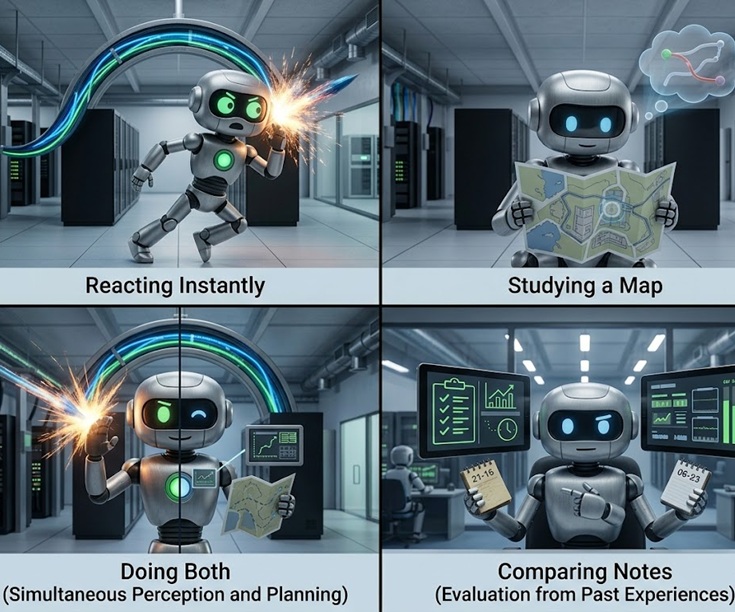
Reactive Agents These operate purely on current input. No memory, no planning, just a direct response to whatever is happening right now. They are fast and predictable but limited to simple, well-defined tasks where conditions rarely change.
Deliberative Agents These maintain an internal model of the world and plan sequences of actions before executing anything. They are slower than reactive agents but far more capable when tasks involve multiple steps or changing conditions.
Hybrid Agents As the name suggests, these combine both approaches. They react quickly to urgent inputs while also maintaining a longer-term plan in the background. Most production-grade agents you will encounter today fall into this category.
Learning Agents These improve their own performance over time by analysing what worked and what did not. They are the most sophisticated type and the most resource-intensive to build and maintain, but they are also the most valuable for tasks that evolve over time.
| Agent Type | Best For | Main Tradeoff |
|---|---|---|
| Reactive | Fast, simple, repeatable tasks | No adaptability |
| Deliberative | Complex, multi-step planning | Slower execution |
| Hybrid | Most real-world business workflows | More complex to build |
| Learning | Long-running, evolving tasks | High resource cost |
Why This Matters for the Work You Are Actually Doing
Here is where the theory gets grounded. Understanding how do AI agents work is useful, but knowing why it matters for your specific situation is what moves this from interesting to actionable.
For developers and technical teams, agents change the ceiling on what automation can achieve. Tasks that previously required hard-coded logic for every edge case can now be handled by an agent that reasons through novel situations on its own. Building on a platform with strong developer features means you spend less time on plumbing and more time on actual product work.
For operations and business teams, agents reduce the amount of human coordination required for complex workflows. A process that normally required three people passing information between tools can often be reduced to a single agent that handles the whole chain.
For anyone evaluating tools, the agent landscape is moving fast. The right question to ask is not which agent is the most impressive in a demo but which one is the most reliable under real conditions, with real data, and real edge cases.
A useful way to start is picking one workflow that is well-documented, moderately complex, and not business-critical. Use it as a testing ground. You will learn more from one real deployment than from reading ten guides, including this one.

Wrapping Up How AI Agents Work
Breaking down how do AI agents work reveals something that is both more straightforward and more powerful than most people expect. The loop of perceiving, reasoning, planning, acting, and evaluating is simple in concept. What makes it remarkable is how much that loop can accomplish when paired with the right tools, memory systems, and a clear goal.
The four agent types give you a framework for matching architecture to task complexity. The five core components give you a checklist for evaluating any agent platform you consider working with. And the practical notes throughout this guide are designed to save you from the most common mistakes before you make them.
If you want to go deeper, the step-by-step guide is a useful next stop for moving from understanding to actual implementation.
Frequently Asked Questions
How exactly do AI agents work?
AI agents follow a continuous loop: they take in information, reason through it using a language model, plan a sequence of actions, execute those actions using tools, and evaluate the result before deciding what to do next.
This cycle repeats until the goal is complete or the agent determines it cannot proceed without more input.
Who are the Big 4 AI agents?
The four most recognised players in the AI agent space are OpenAI, Google, Anthropic, and Microsoft, each offering their own agent-capable models and platforms.
Each brings different strengths. OpenAI leads on model capability, Google on search and data integration, Anthropic on safety-focused reasoning, and Microsoft on enterprise deployment through Copilot and AutoGen.
What are the 5 parts of an AI agent?
The five core components are the perception module, memory, reasoning engine, action module, and learning system.
Together they allow an agent to take in information, understand context, decide what to do, act on those decisions, and improve over time based on what worked and what did not.
What are the 4 types of agents in AI?
The four main types are reactive agents, deliberative agents, hybrid agents, and learning agents.
Reactive agents respond instantly to current inputs. Deliberative agents plan ahead. Hybrid agents do both. Learning agents improve their own behaviour based on past performance.
What are the top 3 AI agents right now?
Three of the most widely adopted AI agent tools currently are LangChain Agents, Microsoft AutoGen, and CrewAI.
LangChain is popular for its flexibility and developer ecosystem. AutoGen excels at multi-agent collaboration for enterprise use cases. CrewAI focuses on role-based agent teams that divide complex tasks among specialised agents.