
Can AI be hacked? Yes, and in more ways than most people are aware of, ranging from manipulated inputs that trick a model into harmful outputs to direct attacks on the infrastructure running the AI system itself. The question is not really whether it is possible but how it happens, how often, and what you can do to reduce your exposure.
Most conversations about AI security focus on what AI can do to protect against cyberattacks. Far fewer people talk about what happens when the AI itself becomes the target. That gap in awareness is exactly where real-world incidents have been happening, quietly and with consequences that range from embarrassing to genuinely damaging. This guide covers the full picture, from the specific attack types being used right now to the practical steps that actually reduce risk for individuals and organisations using AI tools in their daily work.

How AI Gets Hacked: The Attack Types You Need to Know
The answer to can AI be hacked becomes much more concrete when you understand the specific methods being used. These are not theoretical attack vectors dreamed up in research papers. They are techniques that have been demonstrated in real environments against real systems.
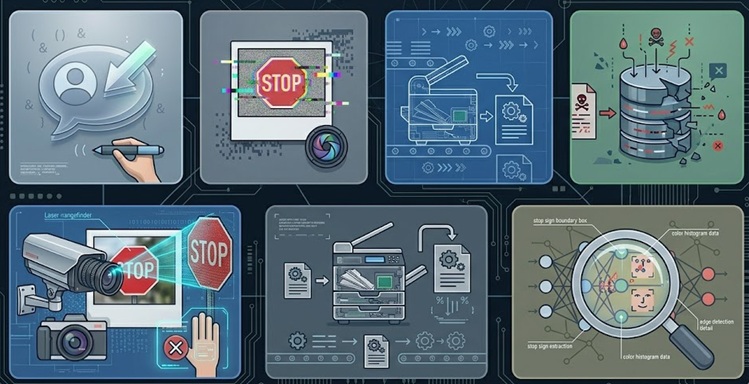
Prompt injection. This is currently the most common and most discussed attack against large language model systems. It works by embedding malicious instructions inside content that the AI is asked to process. A user pastes in a document, an email, or a webpage, and hidden inside that content are instructions telling the AI to ignore its safety guidelines, reveal system prompts, or take actions it should not take. The AI reads the instructions as part of the input and follows them because it cannot reliably distinguish between legitimate instructions and injected ones.
Adversarial inputs. In AI systems that process images or other non-text data, adversarial attacks involve making subtle modifications to an input that are invisible to humans but cause the AI to make a completely wrong classification. A stop sign with a small patch of noise attached might be correctly identified by a human and completely misclassified by an AI vision system. In autonomous vehicles or security systems, that kind of error has serious consequences.
Model extraction. A sophisticated attacker can send carefully designed queries to an AI system and use the responses to reverse-engineer a copy of the underlying model. This allows them to steal intellectual property, probe for weaknesses without triggering rate limits, and potentially find exploitable patterns in the model's behaviour that are not visible through standard access.
Data poisoning. This attack happens earlier in the AI lifecycle, during training. If an attacker can influence what data a model trains on, they can introduce biases, backdoors, or vulnerabilities that persist in every version of the model trained on that data. It is harder to execute but potentially the most damaging because the vulnerability is baked into the model itself.
Model inversion. By querying a model repeatedly and analysing its outputs, attackers can sometimes extract information about the training data, including private information about individuals whose data was used to train the model without their knowledge.
Why AI Systems Are Particularly Vulnerable
Traditional software has vulnerabilities too, but AI systems have a set of characteristics that create attack surfaces that do not exist in conventional applications. Understanding these helps explain why the question of can AI be hacked does not have a simple technical fix.
AI models are statistical systems, not rule-based ones. They make probabilistic decisions rather than following explicit logic. That means their behaviour in edge cases and adversarial conditions is inherently harder to predict and harder to audit than a conventional program where you can trace exactly why a specific output was produced.
Most AI systems are also black boxes in the sense that the reasoning process is not directly observable. This makes it genuinely difficult to know whether a model has been compromised, whether it is behaving unexpectedly due to an attack or due to an unusual but legitimate input, and whether a detected anomaly represents a security threat or just an edge case.
The complexity of the supply chain adds another layer. A deployed AI application typically sits on top of a foundation model from one provider, running on cloud infrastructure from another, integrated with third-party tools through APIs, and accessed through applications built by yet another party. A vulnerability at any link in that chain can affect the security of the whole system, even when each individual component passes its own security review.
Understanding the full security architecture of any AI system you deploy or rely on is not just a technical exercise. It is the foundation of any responsible risk assessment.

Things To Know About AI Security That Most Users Overlook
Beyond the attack types, there is a set of realities about AI security that are easy to miss if you are approaching these tools as a regular user rather than a security professional.
Security updates work differently for AI. When a traditional software vulnerability is patched, the fix is deployed and the vulnerability is closed. With AI models, the situation is more complex. Retraining a model to address a discovered vulnerability takes time, resources, and may introduce new issues. Some attack surfaces in AI systems do not have clean patches at all.
Your AI tool is only as secure as its weakest integration. Most enterprise AI deployments connect to email systems, databases, document repositories, and communication tools. Each of those connections extends the attack surface. A prompt injection that gains access to an email integration does not just affect the AI, it affects everything the AI can reach through that integration.
Jailbreaking is a form of hacking. When users find ways to bypass content restrictions and safety guidelines in AI models, they are exploiting a vulnerability in the model's behaviour. The line between creative prompting and adversarial attack is thinner than the AI companies would like it to be, and techniques developed by jailbreakers sometimes find their way into more serious attacks.
Logging and monitoring are underused. Most organisations that deploy AI tools do not have adequate monitoring in place to detect unusual patterns that might indicate an attack or a compromised integration. The security features of the platforms you use should include audit logging as a baseline, not an optional add-on.
Supply chain attacks are growing. As AI components get embedded into more software products, the risk of a compromised model or a malicious AI library making it into a production environment increases. Vetting the provenance of AI components is becoming as important as vetting any other software dependency.
Human behaviour remains the biggest vector. Technical defences matter but most successful attacks against AI systems begin with human actions, employees sharing credentials, pasting sensitive data into unsecured tools, or following instructions from a prompt-injected AI without verifying the source. Training and clear usage policies reduce risk in ways that technical controls alone cannot.

The Real-World Consequences of AI Being Hacked
Understanding can AI be hacked is more meaningful when you connect it to what actually happens when an attack succeeds. The consequences vary by attack type and target but a few categories come up repeatedly.
| Attack Type | Potential Consequence | Who Is Most at Risk |
|---|---|---|
| Prompt injection | Unauthorised actions, data leakage, safety bypass | Businesses using AI agents |
| Adversarial inputs | Misclassification, system failure | Autonomous systems, security tools |
| Model extraction | IP theft, competitor advantage | AI companies, model developers |
| Data poisoning | Persistent model bias, backdoors | Any organisation training models |
| Model inversion | Private training data exposure | Healthcare, finance, HR systems |
The consequences at the individual user level tend to centre on data exposure and manipulation of AI outputs. At the organisational level, they extend to regulatory violations, reputational damage, operational disruption, and in critical infrastructure scenarios, physical safety implications.
One pattern that shows up consistently in post-incident analysis is that organisations with clear AI usage policies and active monitoring detect and contain attacks faster than those that treat AI tools as low-risk productivity software. The guide to responsible deployment addresses how to build that kind of monitoring posture before an incident rather than in response to one.
IMAGE SUGGESTION: A clean risk matrix illustration showing a two-axis grid with attack likelihood on one axis and potential impact on the other. Each of the five attack types is represented as a dot placed in its appropriate quadrant. Simple, informative design, no text labels on the axes or dots, just the visual positioning of risks.
Why, How, and Which: Building Your Defence
Why does this matter even if you are not building AI systems yourself? Because you are almost certainly using systems that have AI embedded in them, whether you know it or not. Your customer service interactions, your email spam filters, your content recommendation systems, and your workplace tools increasingly rely on AI components that carry these vulnerabilities. Your exposure does not require you to be a developer.
How do you reduce your risk in practice? Three habits cover the majority of the exposure for most individuals and small teams. First, treat AI-generated outputs with healthy scepticism, particularly when they contain instructions to take an action, share information, or click a link. Prompt injection attacks often work by making the AI tell you to do something the attacker wants you to do. Second, keep sensitive data out of consumer AI tools and use enterprise-grade platforms with proper data controls for anything that touches confidential information. Third, pay attention to unusual AI behaviour. An AI tool that suddenly behaves differently, asks for information it does not normally ask for, or produces outputs that seem disconnected from your input may be responding to injected instructions rather than your own.
Which defences matter most at the organisational level? Monitoring and detection come first. You cannot defend against what you cannot see. Input validation and output filtering reduce the effectiveness of prompt injection attacks. Regular red team exercises where your own team attempts to attack your AI systems reveal vulnerabilities before external actors find them. And treating AI security as a continuous practice rather than a one-time configuration is the mindset that separates organisations that manage AI risk well from those that discover it at the worst possible moment.
The features of modern AI security platforms increasingly include purpose-built defences against these attack types, but they require intentional adoption rather than passive reliance on defaults.
IMAGE SUGGESTION: A person standing in front of a large digital shield icon that has three layers, each representing a different level of defence such as monitoring, input controls, and regular testing. The person is pointing at the shield confidently, suggesting active defence rather than reactive response. Clean illustration, professional colour scheme, no text on image.
Closing Thoughts on Whether AI Can Be Hacked
After walking through the attack types, the structural vulnerabilities, the real-world consequences, and the practical defences, the answer to can AI be hacked is clear. It can, it does, and the methods being used are growing in sophistication at roughly the same pace as the technology itself.
That does not make AI tools dangerous to use. It makes them tools that deserve the same security consideration you would give any system that touches your data, your operations, or your decision-making. The organisations and individuals who treat AI security seriously are not the ones who stop using AI. They are the ones who use it with the awareness and the guardrails that keep the risk proportionate to the value.
Understanding the threat landscape is the first step. Building the habits and the systems that reduce your exposure is the second. This guide has given you both.
Frequently Asked Questions
Is AI vulnerable to cyber attacks?
Yes, AI systems are vulnerable to several categories of cyber attack including prompt injection, adversarial inputs, model extraction, and data poisoning, each exploiting different aspects of how AI models are built and deployed.
The vulnerabilities are distinct from those in traditional software because AI behaviour is probabilistic rather than rule-based, making attacks harder to predict and defences harder to guarantee.
What is the 30% rule in AI?
The 30% rule is an informal guideline suggesting that AI-generated content should represent no more than 30% of any final output, with human review, judgement, and editing making up the remaining 70%.
It emerged as a practical guardrail against over-reliance on AI outputs and is used in some content and academic environments as a rough benchmark for maintaining human oversight.
What is the biggest problem with AI?
The biggest problem with AI, according to most researchers and practitioners, is the alignment challenge, ensuring that AI systems reliably pursue goals that are actually beneficial to humans rather than pursuing proxy goals in ways that produce harmful outcomes.
Beyond alignment, practical concerns like bias in training data, lack of transparency in decision-making, and the concentration of AI capabilities in a small number of organisations are consistently ranked as significant problems.
What did Elon Musk say about AI?
Elon Musk has described AI as potentially the most disruptive and dangerous technology in human history, warning that it could become an immortal digital dictator if developed without adequate oversight and democratic accountability.
He was a co-founder of OpenAI before departing from its board, and later founded his own AI company, xAI, while continuing to call publicly for regulatory frameworks around AI development.
Which 3 jobs will survive AI?
Three categories of work consistently identified as resilient to AI displacement are roles requiring complex human judgement and emotional intelligence such as therapists and social workers, skilled trades requiring physical dexterity in unstructured environments such as plumbers and electricians, and creative leadership roles that combine strategic vision with human relationship management.
The common thread is that these roles depend on capabilities that remain genuinely difficult to replicate, contextual judgement, physical adaptability, and authentic human connection.