
AI agent use cases for business cover a wide and rapidly expanding range of operational functions, from automating customer service workflows and processing financial transactions to conducting research, managing compliance monitoring, and coordinating multi-step internal processes that previously required sustained human attention. The common thread across all of them is that AI agents handle work that is too complex, too repetitive, or too time-sensitive for manual processing at the scale modern businesses operate.
The difference between an AI assistant and an AI agent is worth establishing clearly before going further. An assistant responds to prompts. An agent pursues objectives. When you ask a chatbot a question, it answers. When you deploy an agent on a task, it plans the steps required, uses available tools to execute them, evaluates the results, adjusts its approach based on what it finds, and continues working until the objective is achieved or a human checkpoint is reached. That capacity for autonomous, multi-step execution is what makes agents useful for the kinds of business workflows that matter most, and it is also what makes deploying them thoughtfully rather than carelessly an organisational priority. This guide covers the most impactful AI agent use cases for business today, explains why each works the way it does, and addresses the governance considerations that determine whether a deployment creates value or creates problems.

Why AI Agents Are Moving From Experimentation Into Core Business Operations
The Shift From Tools to Active Participants
Most businesses that adopted AI in its early commercial phase treated it as a tool, something you used when you needed it, like a search engine or a calculator. You prompted it, received an output, and decided what to do with that output. The human remained the active participant. The AI produced a useful artefact.
AI agents change that relationship fundamentally. Rather than waiting to be prompted for each step of a multi-part task, an agent works through a sequence of actions, making decisions at each step based on the results of previous ones, until the task is complete or a condition requiring human judgement is reached. The human defines the objective and the guardrails. The agent handles the execution.
This shift matters enormously for business operations because the most expensive and time-consuming parts of most business workflows are not the individual tasks within them. They are the coordination, sequencing, and follow-through across tasks that require sustained attention over extended periods. A human executing a ten-step research and reporting workflow has to hold the full context of the task across every step, manage handoffs between tools and information sources, and maintain quality standards throughout without the attention variability that extended task execution inevitably introduces. An agent does all of this without the cognitive overhead, the variability, or the time constraints that make the same workflow expensive for a human team to execute at scale.
Where Business Value Is Actually Concentrating
Not every AI agent use case for business delivers equivalent value. The applications generating the most measurable return consistently share a set of characteristics. They involve high-frequency execution of defined processes where volume creates cost. They require coordination across multiple information sources or systems that is tedious for humans but straightforward for software. They have clear quality criteria that an agent can check its own outputs against. And they free human expertise for the judgement-intensive work that neither automation nor agents can handle.
Organisations that identify their highest-frequency, most-defined, most-measurable processes as the starting point for agent deployment consistently report better outcomes than those that start with ambitious, loosely defined use cases where success criteria are unclear and agent performance is difficult to evaluate.
Understanding how AI architecture choices affect agent reliability and auditability in high-frequency business processes helps organisations design deployments that scale without the quality degradation that poorly architected agent systems exhibit as usage grows.
The Most Impactful AI Agent Use Cases for Business Today
Customer Service and Support Operations
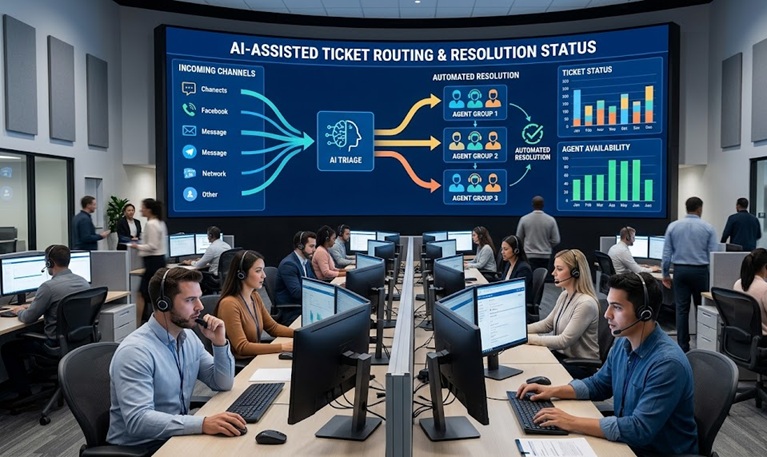
Customer service is both one of the most widely deployed and most mature AI agent use cases for business. The combination of high interaction volume, defined resolution workflows, and measurable outcome quality makes it a natural fit for agent deployment, and the operational evidence from organisations that have deployed agents here is substantially positive.
AI agents in customer service do far more than answer frequently asked questions. A well-deployed customer service agent handles the full resolution workflow for a significant portion of inbound contacts. It retrieves the customer's history and context, identifies the nature of the issue, checks eligibility against current policy, identifies resolution options, executes the resolution where authorisation permits, communicates the outcome to the customer, and logs the interaction for quality monitoring and compliance purposes. That sequence, which requires a human representative to hold multiple systems open simultaneously and coordinate across them for each contact, runs autonomously for contacts that fall within the agent's defined resolution authority.
The human escalation pathway is the critical design element that determines whether this works well or creates customer frustration. Contacts that exceed the agent's authorisation, involve unusual circumstances, or where the customer requests a human representative should reach a human quickly and with full context transferred. The agent's job is handling the contacts it can handle well, not handling every contact regardless of fit.
Sales and Lead Management
Sales operations represent a high-value AI agent deployment area where the combination of data processing, outreach sequencing, and follow-through consistency makes agents significantly more effective than the manually managed equivalents they replace.
AI agents applied to sales workflows handle lead qualification against defined criteria without the inconsistency that human qualification introduces at high volume. They research accounts and contacts before outreach, assembling relevant context from multiple sources that would take a human researcher significant time to gather manually. They execute follow-up sequences with the timing consistency that human sales representatives, managing their own attention across active opportunities, rarely achieve in practice. And they surface prioritisation signals from across a large pipeline that would be invisible to a human reviewing the same data without analytical assistance.
The important boundary in sales agent deployment is between the research, qualification, sequencing, and prioritisation work that agents handle effectively and the relationship-building, negotiation, and trust development that remains distinctly human. Organisations that deploy agents to handle the former while ensuring their sales professionals focus on the latter typically see both efficiency and relationship quality improve simultaneously because humans are no longer spending their attention on administrative coordination that adds no relationship value.
Financial Operations and Compliance Monitoring
Finance and compliance functions represent one of the most compelling AI agent use cases for business because the combination of high-volume rule-based processing, strict accuracy requirements, and significant cost of error creates exactly the conditions where agent deployment delivers measurable value.
Accounts payable and receivable workflows involve large volumes of document processing, matching, verification, and exception handling that agents handle more consistently and at greater scale than manual processing teams. Invoice processing agents extract relevant data from incoming documents, match against purchase orders and contracts, flag exceptions for human review, and route approvals through defined workflows with the audit trail documentation that finance controls require.
Compliance monitoring agents watch transaction streams, communication records, and operational data against regulatory rules continuously rather than through the periodic sampling that manual compliance review depends on. A compliance agent monitoring trading communications for conduct risk issues processes every message rather than a statistical sample, applying consistent rules without the fatigue variability that human reviewers exhibit across long monitoring sessions. Exceptions get escalated to qualified compliance professionals who apply judgement to the cases that genuinely require it, while the agent handles the coverage work that previously consumed the same professionals' time on tasks below their expertise level.
Understanding how AI security and audit trail requirements apply to AI agents operating in regulated financial workflows helps organisations build deployments that satisfy both their operational efficiency goals and the documentation standards that financial regulators expect to see.
| Business Function | Agent Capability | Primary Value Delivered |
|---|---|---|
| Customer Service | Full workflow resolution within defined authority | Volume handling, consistency, 24/7 availability |
| Sales Operations | Lead qualification, research, follow-up sequencing | Pipeline coverage, timing consistency, prioritisation |
| Financial Operations | Document processing, matching, exception routing | Accuracy at scale, audit trail, processing speed |
| Compliance Monitoring | Continuous rule-based surveillance, exception escalation | Coverage completeness, consistency, expert time liberation |
| IT Operations | Incident detection, diagnosis, resolution execution | Response speed, coverage continuity, escalation quality |
| HR Operations | Candidate screening, onboarding coordination, query handling | Process consistency, administrative efficiency |
Research, Intelligence, and Knowledge Management
Research-intensive business functions including competitive intelligence, market analysis, regulatory monitoring, and internal knowledge management are AI agent use cases for business where the combination of multi-source information gathering, synthesis, and ongoing monitoring makes agent deployment particularly valuable.
A competitive intelligence agent deployed on a continuous monitoring brief tracks competitor announcements, regulatory filings, patent publications, and media coverage across defined sources, surfaces relevant developments against the organisation's intelligence requirements, and assembles regular briefings that synthesise findings across the monitored landscape. The same coverage run manually requires analyst time proportional to the breadth of monitoring required. An agent provides consistent, comprehensive coverage at a small fraction of that resource investment.
Internal knowledge management agents help organisations make the institutional knowledge locked in their documentation, past projects, and accumulated processes accessible in real time to employees who need it. Rather than spending time searching through repositories of uneven organisation and currency, employees query an agent that retrieves and synthesises relevant knowledge on demand. The agent does not replace the expertise of the people who created that knowledge. It makes that expertise accessible to everyone who needs it, not just the individuals who happen to know where it is stored or who to ask.
Reviewing how AI features in enterprise agent platforms handle source attribution and knowledge base access controls helps organisations deploy research and knowledge agents that produce verifiable, appropriately restricted outputs rather than unattributed synthesis that cannot be checked or access-controlled effectively.

IT Operations and Infrastructure Management
IT operations represents a high-value deployment area for AI agents because the combination of continuous monitoring requirements, defined response playbooks, and significant cost of slow incident response creates the conditions where agent autonomy delivers measurable operational benefit.
IT operations agents monitor infrastructure health, application performance, and security event streams continuously, applying defined diagnostic logic to identify anomalies and their likely causes before escalating to human engineers with diagnosis context already assembled. The human engineer who receives an escalation from a well-deployed IT operations agent arrives at the problem with the event timeline, the likely cause assessment, the relevant historical incidents, and the standard resolution procedures already available, rather than spending the first significant portion of their response time assembling that context from multiple monitoring systems.
Agents authorised to execute defined remediation actions, restarting services, scaling resources, applying standard patches, isolating potentially compromised systems, handle the routine resolution cases autonomously while escalating the genuinely novel or high-impact situations that require expert judgement. The result is faster mean time to resolution across the majority of incidents and better-prepared human response to the minority of incidents that genuinely need expert attention.
Designing AI Agent Deployments That Work in Practice
Defining Authorisation Boundaries Before Deployment
The most important design decision in any AI agent deployment for business is defining what the agent is authorised to do autonomously versus what requires human approval before execution. This decision determines the agent's operational value and the risk profile of the deployment simultaneously, and getting it right requires thinking carefully about the consequence of the agent acting incorrectly in each action category.
A useful framework divides agent actions into three categories. Fully autonomous actions are those where the consequence of an agent error is low, the action is easily reversible, and the volume benefit of autonomous execution is high. Information retrieval, status checking, draft generation, and notification sending within defined parameters typically fall here. Human-in-the-loop actions are those where the consequence of an error is moderate, irreversibility is partial, or the situation has characteristics that make rule-based authorisation unreliable. These actions are prepared by the agent and reviewed by a human before execution. Fully human-authorised actions are those with significant consequences, material irreversibility, or regulatory accountability requirements. These require human decision and authorisation regardless of agent capability because the accountability for them cannot appropriately rest with an automated system.
The 30% principle is a practical starting point for this design work. Agents should execute the high-frequency, well-defined, lower-consequence actions that constitute roughly 30% of workflow activity autonomously, while human judgement and authorisation cover the 70% that involves consequential decisions, unusual situations, and accountability that needs to rest with a person rather than a system.
Measurement, Monitoring, and Iteration
AI agent deployments that deliver sustained value are actively managed rather than deployed and forgotten. The performance of an agent on its defined objectives, the rate at which it escalates to human review, the quality of its autonomous resolutions, and the patterns in its escalation reasons all provide operational intelligence that should inform ongoing refinement.
Agents that escalate too frequently are often insufficiently authorised or poorly configured for their actual task environment. Agents that rarely escalate may be exceeding their appropriate authority without the oversight that consequential actions require. Finding and maintaining the right escalation rate for each deployment requires ongoing monitoring and adjustment rather than a one-time configuration.
A comprehensive AI guide on establishing performance measurement frameworks for business AI agents helps organisations build the operational discipline that turns initial deployments into continuously improving business assets rather than static automations that drift in quality as their operating environment evolves.

Things To Know
Several important considerations about AI agent use cases for business that organisations consistently discover through deployment experience:
Start narrower than feels ambitious. The AI agent deployments that deliver the most reliable initial value are those with clearly defined scope, measurable success criteria, and a well-understood operating environment. Broad, ambitious deployments with vague success criteria produce learning but rarely deliver the operational value that builds organisational confidence and executive support for further investment.
Agent performance degrades gracefully only if fallback paths are designed. When an agent encounters a situation outside its defined operating parameters, the quality of the outcome depends entirely on the fallback path designed into the system. Agents without clear escalation and handoff processes either fail visibly or, worse, produce low-quality autonomous outputs in situations where they should have handed off to a human.
Logging every agent action is an operational requirement, not an optional enhancement. The ability to audit what an agent did, in what sequence, on what inputs, and with what authorisation is essential for quality improvement, incident investigation, and regulatory compliance in any business context. Organisations that treat logging as a nice-to-have discover during their first incident that reconstruction of agent behaviour without comprehensive logs is effectively impossible.
Agents inherit the data access risks of the systems they connect to. An agent with access to your CRM, your financial systems, and your email infrastructure is a high-value target if its access controls are not as rigorous as those of the systems themselves. Access management for agents requires the same discipline as access management for privileged human users.
User trust in agent outputs takes time to develop and can be damaged quickly. Employees who receive work products or decisions from AI agents develop trust based on their experience of agent quality over time. A period of high-quality autonomous performance builds trust that accelerates adoption. A significant error, particularly one with visible consequences, damages that trust in ways that take much longer to rebuild than they took to establish.
The seven functional types of AI agents in business contexts are information retrieval agents, workflow automation agents, monitoring and alerting agents, decision support agents, communication agents, research and synthesis agents, and coordination agents. Most practical business deployments combine multiple functional types within a single deployment, which is why defining the authorisation boundary for each functional type is more operationally useful than categorising the overall deployment into a single type.
Vendor landscape for agent infrastructure is evolving faster than most enterprise procurement cycles. The platforms, frameworks, and foundation models that power agent deployments are changing significantly year over year. Building agent architectures with clear separation between the business logic and the underlying model and platform reduces the cost of adapting to that change rather than being locked into infrastructure choices that made sense at deployment but become limiting as the landscape evolves.
The Business Case for AI Agent Investment Is Now Operational, Not Speculative
The conversation about AI agent use cases for business has shifted from whether agents will deliver real value to which deployments are delivering the most value and what the organisational factors are that determine success. The operational evidence from organisations that have moved past experimentation into production deployment is consistent and growing. High-frequency, well-defined processes with measurable outcomes and clear escalation paths are delivering efficiency gains, quality consistency improvements, and staff time reallocation toward higher-value work that the pre-deployment business cases projected.
The organisations capturing that value are not necessarily the ones that moved fastest. They are the ones that defined their authorisation boundaries carefully, built measurement and oversight into their deployments from the start, and maintained the governance discipline to keep humans accountable for the decisions that agents support rather than make. That combination of capability deployment and governance discipline is what transforms AI agent investment from an interesting experiment into a durable competitive advantage.
Frequently Asked Questions
What are the use cases of AI agents in business?
AI agent use cases in business span customer service workflow automation, sales lead qualification and follow-up, financial document processing and compliance monitoring, IT operations incident response, competitive intelligence and research synthesis, internal knowledge management, and HR process coordination. The use cases delivering the most consistent value share three characteristics: high execution frequency, well-defined success criteria, and clear authorisation boundaries that determine what the agent handles autonomously versus what escalates to human review.
What are some common AI use cases in business?
The most common AI use cases in business today are customer service automation, sales assistance and pipeline management, document processing and data extraction, compliance monitoring and reporting, code generation and review, internal search and knowledge retrieval, and scheduling and workflow coordination. Across these applications the common business driver is handling high-volume, defined-process work at a consistency and scale that manual execution cannot match cost-effectively, freeing human expertise for the judgement-intensive work that drives the most strategic business value.
What is the 30% rule for AI?
The 30% rule for AI is the principle that AI agents should handle approximately 30% of a workflow autonomously, specifically the high-frequency, well-defined, and lower-consequence actions where automation delivers clear efficiency benefits, while human judgement and accountability cover the remaining 70% involving consequential decisions, unusual situations, and outputs that carry organisational or regulatory accountability. In agent deployment design this principle translates directly into authorisation boundary decisions that determine which agent actions are fully autonomous, which require human review before execution, and which require human decision and authorisation regardless of agent capability.
What are AI agents for business applications?
AI agents for business applications are software systems that pursue defined objectives through autonomous multi-step execution, using available tools and data sources to plan, execute, evaluate, and adjust their actions until an objective is achieved or a human checkpoint is reached. Unlike AI assistants that respond to individual prompts, agents maintain task context across multiple steps, make intermediate decisions based on results encountered during execution, and handle the coordination and follow-through across complex workflows that makes them valuable for the kinds of sustained, multi-step business processes where human execution is most expensive and most variable in quality.
What are the 7 types of AI agents?
The seven functional types of AI agents in business contexts are information retrieval agents that gather and synthesise data from defined sources, workflow automation agents that execute defined multi-step processes, monitoring and alerting agents that watch streams of data against defined rules, decision support agents that analyse options and recommend actions for human review, communication agents that draft and manage outbound messaging, research and synthesis agents that conduct multi-source analysis, and coordination agents that manage sequencing and handoffs across other agents or human participants. Most production business deployments combine multiple functional types within a single deployed system, with the specific combination determined by the workflow being automated rather than by any single agent type classification.